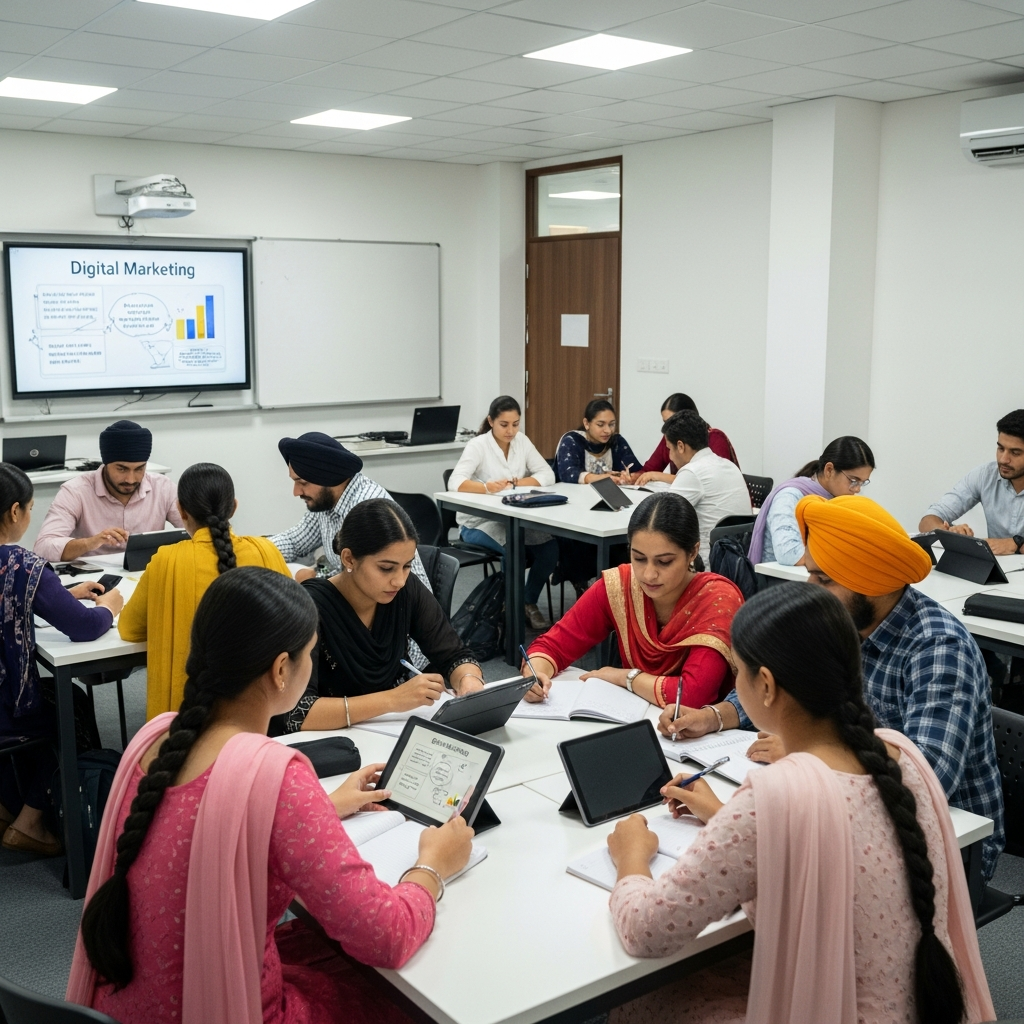
12th Board results drop. And suddenly everyone around you has an opinion.
Your parents want MBBS or B.Tech. Your friends are all going for BBA. Your school counsellor handed you a brochure that was probably printed in 2014. And somewhere in the middle of all that noise, you have to make one of the biggest decisions of your life.
No pressure, right?
Here is the truth nobody tells you clearly: there is no single best course after 12th. There is only the best course for you — based on what you enjoy, what you are good at, and where the job market is actually heading.
This guide covers all three streams — Science, Commerce, and Arts — with real salary numbers, honest career scope, eligibility details, fees, and future demand for 30 courses. No fluff. No outdated information.
What Are the Best Courses After 12th?
| Quick Answer Science: MBBS, B.Tech, BCA, Data Science, AI, Nursing, B.Pharm, BDS, Biotechnology, Cyber Security. Commerce: CA, BBA, B.Com, CS, CMA, Finance, Investment Banking, Business Analytics, Digital Marketing, SEO and GEO. Highest salary: MBBS, B.Tech from IIT, CA, Data Science, Investment Banking. |
How To Choose the Right Course After 12th
Most students pick a course one of three ways: their parents decide, their friends decide, or they pick whatever sounds most impressive at family dinners. None of those are good strategies.
Here is a framework that actually works.
Interest — If a subject bored you in class, it will drain you at work. Start with what genuinely holds your attention. Take a free RIASEC aptitude test online if you are unsure.
Skills — Every career has a skill baseline. Medicine needs memorisation and empathy. Data Science needs maths and logic. Law needs reading speed and argumentation. Match the course to what you are already reasonably good at.
Career Goals — Think about where you want to be at 30 — the lifestyle, the work environment, the problems you want to solve. Work backward from that vision. Most students work forward from a brochure, which is the wrong direction.
Future Demand — A course that was booming ten years ago may be struggling for placements today. Before enrolling anywhere, check LinkedIn job postings, NASSCOM hiring reports, and WEF Future of Jobs data for that specific field.
Salary Potential — Look at the starting salary and the 10-year ceiling. MBBS starts moderate and can hit 30 to 50 LPA with specialisation. B.Tech CS can cross 1 crore in senior global roles. The first paycheck is never the whole picture.
Job Availability — How many active openings exist on Naukri and LinkedIn right now for someone with that degree? Under 1,000 nationally is a warning sign worth taking seriously before you commit four or five years of your life.
| Factor | Why It Matters | Where to Check |
| Interest | Sustains long-term effort and performance | RIASEC Test, Holland Code, aptitude assessments |
| Skills | Matches your strengths to career requirements | SWOT analysis, college aptitude tests |
| Career Goals | Aligns education with your 5 to 10 year vision | LinkedIn, industry professionals, mentors |
| Future Demand | Prevents picking a field that is in decline | WEF Jobs Report, NASSCOM, LinkedIn Trends |
| Salary Potential | Measures your education return on investment | AmbitionBox, Glassdoor, Payscale India |
| Job Availability | Confirms active hiring in your target field | Naukri.com, LinkedIn Jobs, Indeed India |
Best Courses After 12th Science
Science students often feel the pressure to either crack NEET and get into medicine or clear JEE and go into engineering. Those are strong choices — but they are not the only ones. Here are the ten best courses for 12th Science students in 2026.
| Quick Answer Top Science choices: MBBS, B.Tech, BCA, B.Pharm, Data Science, AI, Cyber Security, Biotechnology, Nursing, and BDS. MBBS and B.Tech remain the most popular. Data Science and AI are the fastest-growing fields in 2026. |
- MBBS
(Bachelor of Medicine, Bachelor of Surgery)
MBBS is India’s most respected medical degree. It takes 5.5 years and requires clearing NEET-UG. Government seats at AIIMS, JIPMER, and state medical colleges are intensely competitive but represent exceptional value. Private MBBS is available but expensive. The career ceiling is among the highest of any profession in India.
| Eligibility | Duration | Fees | Entrance Exam |
| 12th PCB, min 50%, NEET-UG | 5.5 years (4.5 academic + 1 year internship) | Govt: 5,000 to 50,000 per year | Private: 10 to 70 lakh per year | NEET-UG |
Salary: Starting 8 to 12 LPA. Senior specialist with MD or MS: 20 to 50 LPA. Established private practitioner: 1 crore plus annually.
Career Scope: General Physician, Surgeon, Medical Officer, Healthcare Consultant, Medical Researcher, Hospital Administrator
Future Demand: Very High. India needs over 600,000 more doctors by 2030 per WHO estimates. Post-pandemic healthcare investment has only widened that gap.
| Pros | Cons |
| Highest social respect of any profession in India | NEET extremely competitive with 20 lakh plus annual applicants |
| Recession-proof income across all economic cycles | Long study timeline before meaningful earning begins |
| Government hospital job options widely available | Physically and emotionally demanding across career |
| Strong and growing global demand | Private college fees are prohibitive for many families |
| Multiple post-MBBS specialisation pathways |
- BDS
(Bachelor of Dental Surgery)
BDS is the dental equivalent of MBBS — five years, NEET mandatory, and a clear pathway to either hospital-based dentistry or your own clinic. A strong choice for PCB students who want a healthcare career without competing for the top MBBS cutoff.
| Eligibility | Duration | Fees | Entrance Exam |
| 12th PCB, NEET-UG qualified | 5 years | Govt: approx. 2 lakh per year | Private: 10 to 20 lakh per year | NEET-UG |
Salary: Starting 4 to 6 LPA. With MDS specialisation or own practice: 10 to 25 LPA.
Career Scope: Dentist, Oral Surgeon, Dental Clinic Owner, Orthodontist, Periodontist, Academic Researcher
Future Demand: Growing steadily as dental hygiene awareness rises across urban and semi-urban India.
| Pros | Cons |
| Own practice potential from day one | NEET mandatory with no alternative pathway |
| Better work-life balance compared to MBBS | Career ceiling is limited without MDS specialisation |
| Dental awareness and spending growing rapidly across India | Clinic setup and dental equipment costs are significant |
- B.Tech
(Bachelor of Technology)
B.Tech is India’s most popular undergraduate degree. Computer Science, AI, Data Science, Mechanical, Electrical, and Electronics are the major specialisations. IIT and NIT graduates regularly command packages that make headlines, but even mid-tier B.Tech graduates in CS or AI are in strong demand across the country.
| Eligibility | Duration | Fees | Entrance Exam |
| 12th PCM, JEE Main or Advanced, BITSAT for BITS Pilani | 4 years | IITs: 2 to 2.5 lakh per year | Private colleges: 1 to 5 lakh per year | JEE Main, JEE Advanced, BITSAT |
Salary: Starting 6 to 10 LPA for most colleges. IIT and NIT average: 15 to 25 LPA. Senior global tech roles: 50 lakh to 3 crore.
Career Scope: Software Engineer, Data Engineer, AI Developer, Systems Architect, Product Manager, Startup Founder
Future Demand: Exceptional, especially for CS, AI, and Cyber Security. India’s tech sector adds 3 lakh plus jobs every year.
| Pros | Cons |
| Highest salary potential of any undergraduate degree in India | JEE is extremely competitive with millions of serious aspirants |
| Strong global job opportunities across every major market | Massive quality gap between top institutes and private colleges |
| Diverse specialisations to match different interests | Industry demands constant upskilling — a degree alone is not sufficient |
| Clear pathway into entrepreneurship and product development |
- BCA
(Bachelor of Computer Applications)
BCA is the more accessible technology degree — open to students from any stream, three years long, and significantly cheaper than B.Tech. It covers programming, software development, databases, and networking. Combine it with strong industry certifications and the employability gap with B.Tech narrows considerably.
| Eligibility | Duration | Fees | Entrance Exam |
| 12th any stream, Mathematics preferred by most colleges | 3 years | 50,000 to 3 lakh per year | Merit-based or entrance-based depending on college |
Salary: Starting 3 to 5 LPA. With MCA or strong industry certifications: 8 to 18 LPA.
Career Scope: Web Developer, Software Tester, IT Analyst, Database Administrator, Mobile App Developer
Future Demand: High. IT hiring continues to grow across startups, service companies, and product firms throughout India.
| Pros | Cons |
| More affordable than B.Tech with comparable IT job access | Considered a tier below B.Tech by top product company recruiters |
| Open to students from all streams, not just PCM | Requires strong self-learning discipline to stay competitive |
| MCA pathway available for those who want to go deeper | Entry-level IT market is competitive at the fresher stage |
| High demand across the Indian IT sector |
- B.Pharm
(Bachelor of Pharmacy)
B.Pharm is a four-year pharmaceutical sciences degree covering drug formulation, pharmacology, chemistry, and clinical practice. India is the world’s third-largest pharmaceutical market, which creates consistent hiring for graduates who choose this career path.
| Eligibility | Duration | Fees | Entrance Exam |
| 12th PCB or PCM, minimum 50 percent marks | 4 years | 40,000 to 2 lakh per year | State or national pharma entrance exams |
Salary: Starting 2.5 to 4 LPA. With M.Pharm or industry experience: 7 to 15 LPA.
Career Scope: Pharmacist, Drug Inspector, Quality Control Analyst, Pharma Sales Representative, Clinical Research Associate, R and D Scientist
Future Demand: Moderate to High. India’s pharmaceutical export market ensures steady and consistent hiring for qualified graduates.
| Pros | Cons |
| Booming pharmaceutical industry with global reach | Starting salary is on the lower side compared to engineering |
| Government Drug Inspector roles available through PSC exams | R and D roles require M.Pharm or postgraduate specialisation |
| Healthcare-adjacent career with real societal contribution | Pharma sales roles involve significant targets and field pressure |
- Biotechnology
(B.Sc or B.Tech Biotechnology)
Biotechnology sits at the intersection of biology and engineering. Applications range from new medicines and diagnostics to agricultural solutions and biofuels. The global biotech sector grew significantly after 2020 and India is actively expanding its biotech infrastructure with government-backed policy support.
| Eligibility | Duration | Fees | Entrance Exam |
| 12th PCB or PCM, minimum 55 percent marks | 3 years for B.Sc, 4 years for B.Tech | 1 to 8 lakh per year depending on college | JEE or NEET or State Entrance depending on college type |
Salary: Starting 3 to 5 LPA. Senior roles in MNCs or research institutes: 8 to 20 LPA.
Career Scope: Biotech Researcher, Lab Scientist, Genetic Engineer, Clinical Trial Specialist, Quality Assurance in Pharma, Medical Biotech Analyst
Future Demand: High and growing — especially in gene therapy, diagnostics, and agri-biotech segments. India’s biotech sector grows at 15 percent annually.
| Pros | Cons |
| High global demand across pharma, agri-tech, and diagnostics | Top industry roles typically require M.Sc or Ph.D |
| Interdisciplinary field with genuine innovation scope | Industry jobs without postgraduate qualification are limited in scope and salary |
| Strong research and academic career opportunities available |
- Data Science
(B.Sc or B.Tech Data Science)
Ask any tech recruiter what the single most-demanded skill is in 2026 and the answer is almost always Data Science or something adjacent to it. This discipline extracts actionable insights from data using statistics, machine learning, and programming. Every industry — banking, healthcare, retail, logistics — runs on data decisions now.
| Eligibility | Duration | Fees | Entrance Exam |
| 12th PCM or Computer Science, strong Mathematics background essential | 3 years for B.Sc, 4 years for B.Tech | 1 to 5 lakh per year | Merit-based, JEE, or State Entrance depending on college |
Salary: Starting 6 to 10 LPA. Mid-level: 12 to 25 LPA. Senior roles: 30 to 80 LPA.
Career Scope: Data Scientist, Machine Learning Engineer, Business Intelligence Analyst, AI Product Manager, Data Architect, Research Scientist
Future Demand: India alone needs 3 lakh plus Data Science professionals annually. Global demand is even higher, with shortages across US, UK, and Southeast Asia.
| Pros | Cons |
| Number one growth career globally for the past three consecutive years | Needs genuine mathematical aptitude — not suitable for everyone |
| Strong remote and international job opportunities | Field evolves extremely fast and continuous learning is non-negotiable |
| 50 lakh plus salary potential at senior level in top companies | |
| Applicable in every industry, not just technology |
- Artificial Intelligence
(B.Tech AI or B.Sc AI and ML)
AI is not just a technology trend. It is the foundation of how every major industry — finance, healthcare, manufacturing, education, logistics — will function over the next decade. If you have strong maths and enjoy complex problem-solving, AI Engineering might be the single best career choice available to a 12th student in 2026.
| Eligibility | Duration | Fees | Entrance Exam |
| 12th PCM, strong Mathematics background | 4 years | 2 to 8 lakh per year | JEE Main or State Entrance depending on college |
Salary: Starting 8 to 12 LPA. Senior AI Engineers at global product companies: 25 to 80 LPA.
Career Scope: AI Engineer, Machine Learning Researcher, NLP Specialist, AI Product Manager, Robotics Engineer, Computer Vision Expert
Future Demand: Near-perfect future demand. AI is projected to contribute 967 billion dollars to India’s GDP by 2035 according to NASSCOM research.
| Pros | Cons |
| Foundation of every major industry going forward | Technically very demanding — not suited for those with weak maths |
| Exceptional salary potential at all experience levels | Tools and frameworks change rapidly, requiring non-stop learning |
| Strong research, patent, and product innovation scope | Dedicated AI degree programmes in India are still limited in number |
| India’s AI startup ecosystem is growing at record pace |
- Cyber Security
(B.Tech or B.Sc Cyber Security)
India experiences over 80,000 cyberattacks every single day. Every government department, bank, hospital, and e-commerce company needs trained professionals who can defend against them. Cyber Security is one of the rare technology fields where demand genuinely outpaces supply — which gives graduates real negotiating power.
| Eligibility | Duration | Fees | Entrance Exam |
| 12th PCM or Computer Science, minimum 50 percent marks | 3 to 4 years | 1 to 6 lakh per year | JEE Main, Merit, or State Entrance depending on college |
Salary: Starting 5 to 8 LPA. Senior Analyst: 15 to 40 LPA. CISO roles at large organisations: 50 to 80 LPA.
Career Scope: Ethical Hacker, Security Analyst, SOC Analyst, Penetration Tester, Chief Information Security Officer, Cyber Forensic Expert
Future Demand: Very High. Cybercrime costs India 20,000 crore annually. The threat is growing, not shrinking, which keeps this field perpetually undersupplied.
| Pros | Cons |
| Near-zero unemployment in this specific field | High-pressure role with rapidly evolving threat landscape |
| Both government and private sector hiring urgently and consistently | Significant ethical and legal responsibilities come with the territory |
| International certifications like CEH and CISSP provide global career mobility |
- B.Sc Nursing
(Bachelor of Science in Nursing)
India produces some of the world’s most capable nurses. While domestic starting salaries are modest, the international picture is entirely different. The UK NHS, US hospitals, Canadian healthcare systems, and Middle East facilities actively recruit Indian nurses — and pay 20 to 50 LPA for qualified staff. The migration pathway is well-established and growing.
| Eligibility | Duration | Fees | Entrance Exam |
| 12th PCB, minimum 45 percent marks, NEET preferred in most states | 4 years | 30,000 to 1.5 lakh per year | NEET or State Nursing Entrance depending on state |
Salary: India: 2.5 to 4 LPA. Abroad in UK, USA, Canada, Middle East: 20 to 50 LPA.
Career Scope: Staff Nurse, ICU Nurse, ER Nurse, Nurse Educator, Healthcare Manager, International Nurse
Future Demand: High. India needs 2.4 million more nurses by 2030. Global healthcare systems are actively recruiting and this trend is projected to continue.
| Pros | Cons |
| Enormous international demand with established recruitment pathways | Starting salary in India is low relative to effort and training |
| Very affordable education compared to other healthcare degrees | Physically demanding role with regular irregular shift hours |
| Strong government hospital employment across all Indian states | |
| Clear migration pathway to UK, Canada, and Middle East |
Science Courses — Quick Comparison Table
| Course | Duration | Eligibility | Starting Salary | Top Recruiters | Future Scope |
| MBBS | 5.5 Yrs | PCB + NEET | 8 to 12 LPA | AIIMS, Apollo, Govt Hospitals | Exceptional |
| BDS | 5 Yrs | PCB + NEET | 4 to 6 LPA | Hospitals, Own Practice | Very High |
| B.Tech CS or AI | 4 Yrs | PCM + JEE | 6 to 10 LPA | TCS, Google, Amazon, Infosys | Exceptional |
| BCA | 3 Yrs | Any + Maths | 3 to 5 LPA | Wipro, HCL, Startups | High |
| B.Pharm | 4 Yrs | PCB or PCM | 2.5 to 4 LPA | Sun Pharma, Cipla, MNCs | Medium-High |
| Biotechnology | 3-4 Yrs | PCB or PCM | 3 to 5 LPA | Biocon, CSIR, Pharma Cos. | High |
| Data Science | 3-4 Yrs | PCM or CS | 6 to 10 LPA | Amazon, Flipkart, Accenture | Exceptional |
| Artificial Intelligence | 4 Yrs | PCM + Maths | 8 to 12 LPA | Google, Microsoft, Meta, TCS | Exceptional |
| Cyber Security | 3-4 Yrs | PCM or CS | 5 to 8 LPA | DRDO, IBM, Cisco, Startups | Very High |
| B.Sc Nursing | 4 Yrs | PCB | 2.5 to 4 LPA | AIIMS, Apollo, NHS UK | High |
Best Courses After 12th Commerce
Commerce students have access to some of the most financially rewarding careers in India — but only if they choose smart. The difference between a B.Com graduate earning 3 LPA and a CA earning 12 LPA often comes down entirely to the professional qualification built on top of the undergraduate degree.
| Quick Answer Top Commerce choices: CA, BBA, B.Com, CS, CMA, Finance, Investment Banking, Business Analytics, Digital Marketing, SEO and GEO. CA remains the gold standard. Digital Marketing and Business Analytics are the fastest-growing in 2026. |
- B.Com
(Bachelor of Commerce)
B.Com is India’s most enrolled commerce degree — and also the most misunderstood. On its own, it gets you a decent starting point in the job market. Paired with CA, MBA, or a specialised certification in finance or analytics, it becomes a genuine launchpad.
| Eligibility | Duration | Fees | Entrance Exam |
| 12th Commerce, minimum 50 percent marks | 3 years | 10,000 to 1.5 lakh per year | Merit-based, CUET, or College Entrance depending on institution |
Salary: Starting 2.5 to 4 LPA. With CA or MBA: 8 to 25 LPA.
Career Scope: Accountant, Tax Consultant, Financial Analyst, Bank Officer, Auditor, Government Revenue Services
Future Demand: Steady. Accounting and finance roles exist in every industry across India regardless of economic cycle.
| Pros | Cons |
| Very affordable and accessible to students from all backgrounds | Insufficient alone for strong salary growth beyond entry level |
| Gateway to CA, MBA, and banking career pathways | Market is saturated at the basic B.Com level without additional qualifications |
| Multiple entry-level job options available immediately after graduation | Postgraduate qualification or professional certification is strongly recommended |
- BBA
(Bachelor of Business Administration)
BBA is the management degree that feeds India’s top MBA programmes. It covers marketing, HR, finance, operations, and entrepreneurship. Students from IIM Indore’s IPM, Symbiosis, and NMIMS graduate with strong management foundations and competitive MBA entrance exam performance.
| Eligibility | Duration | Fees | Entrance Exam |
| 12th from any stream, minimum 50 percent marks | 3 years | 50,000 to 5 lakh per year depending on college | DU JAT, IPMAT, SET, or college-specific entrance |
Salary: Starting 3 to 5 LPA. With a strong MBA from top institution: 10 to 25 LPA.
Career Scope: Marketing Executive, HR Professional, Operations Manager, Business Analyst, Entrepreneur, Startup Founder
Future Demand: Good. Management and business skills are required across every industry in India.
| Pros | Cons |
| Strongest foundation available for MBA programmes | MBA strongly needed to reach top salary bands |
| Diverse career paths across marketing, HR, finance, and operations | Private college fees can be high relative to placement outcomes at many institutions |
| Open to students from all streams, not just Commerce | |
| Entrepreneurship-ready curriculum at many leading colleges |
- CA
(Chartered Accountancy)
CA is India’s most prestigious finance and accounting qualification, governed by ICAI. Every listed company in India is legally required to have a Chartered Accountant for statutory audit. The exams are notoriously difficult — but that difficulty is precisely what makes the credential so valuable in the job market.
| Eligibility | Duration | Fees | Entrance Exam |
| Any 12th student from any stream can register for CA Foundation | 4 to 5 years covering Foundation, Intermediate, Articleship, and Final | Total ICAI fees are 1 to 2 lakh; coaching is additional | ICAI CA Foundation, Intermediate, and Final examinations |
Salary: Starting 7 to 12 LPA. Big 4 accounting firm freshers: 7 to 10 LPA. Senior CA and CFO roles: 25 to 60 LPA.
Career Scope: Chartered Accountant, CFO, Statutory Auditor, Tax Consultant, Investment Banker, Financial Controller
Future Demand: Very High. GST compliance, SEBI regulations, and India’s expanding corporate sector all drive consistent and growing CA demand.
| Pros | Cons |
| Highest-paid commerce career available in India | Among India’s toughest professional examinations by any measure |
| Globally recognised qualification in Commonwealth and beyond | 4 to 5 year timeline before full qualification and high earning |
| Multiple specialisation paths including tax, audit, and corporate finance | Single-digit pass rates at the Final level require exceptional dedication |
| Total education cost through ICAI is surprisingly low given the career returns |
- CS
(Company Secretary)
Every public company in India above a certain paid-up capital threshold is legally required to employ a Company Secretary under the Companies Act. That legal mandate is what makes CS one of the most stable commerce qualifications available — demand is not discretionary, it is compulsory.
| Eligibility | Duration | Fees | Entrance Exam |
| 12th from any stream | 3 to 4 years covering Foundation, Executive, and Professional levels | 50,000 to 1 lakh total through ICSI | ICSI Foundation, Executive, and Professional examinations |
Salary: Starting 4 to 7 LPA. Senior Company Secretaries in large corporates: 12 to 25 LPA.
Career Scope: Company Secretary, Compliance Officer, Legal Advisor, Corporate Governance Specialist, Board Consultant
Future Demand: Steady. India’s increasing regulatory complexity keeps CS demand consistent across corporate India.
| Pros | Cons |
| Legally mandated role in companies above threshold — guaranteed demand | Career growth tends to be slower compared to CA |
| Good corporate sector placement at entry and mid level | Less widely recognised outside established corporate circles |
| Very affordable qualification with low total cost through ICSI |
- CMA
(Cost and Management Accountancy)
CMA from ICMAI is a professional finance qualification focused on cost control, management accounting, and financial strategy. It is particularly valued in manufacturing, PSUs, infrastructure, and government sectors — areas where CA graduates are comparatively less common.
| Eligibility | Duration | Fees | Entrance Exam |
| 12th from any stream | 3 to 4 years covering Foundation, Intermediate, and Final | 40,000 to 80,000 total through ICMAI | ICMAI Foundation, Intermediate, and Final examinations |
Salary: Starting 4 to 6 LPA. Experienced CMAs in senior roles: 12 to 20 LPA.
Career Scope: Cost Accountant, Financial Controller, Management Consultant, Budget Analyst, Internal Auditor
Future Demand: Moderate to Good, particularly in PSUs, infrastructure companies, and large manufacturing conglomerates.
| Pros | Cons |
| Lower competition than CA makes qualification more accessible | Less brand recognition than CA in most private sector environments |
| Strong and consistent PSU and government sector demand | Fewer pure private industry roles compared to CA at senior levels |
| Very affordable total qualification cost through ICMAI |
- Finance Specialisation
(B.Com Finance or BBA Finance)
A Finance specialisation covers stock markets, corporate finance, portfolio management, derivatives, and financial modelling. It is the natural academic entry point for careers in banking, wealth management, capital markets, and financial advisory services.
| Eligibility | Duration | Fees | Entrance Exam |
| 12th Commerce, minimum 50 percent marks | 3 years | 40,000 to 3 lakh per year | Merit-based or entrance-based depending on institution |
Salary: Starting 3 to 5 LPA. With CFA certification or MBA Finance from a good institution: 12 to 30 LPA.
Career Scope: Financial Analyst, Investment Advisor, Portfolio Manager, Risk Analyst, Bank Officer, Credit Analyst
Future Demand: Strong. India’s BFSI sector is projected to grow significantly through 2030, creating sustained demand.
| Pros | Cons |
| BFSI sector is actively growing and hiring across all city tiers | Postgraduate qualification is usually required to reach senior finance roles |
| CFA and CFP international certification pathways widely available | Staying current with financial markets requires consistent effort and reading |
| High salary ceiling at senior levels in capital markets and wealth management |
- Investment Banking
(B.Com or BBA followed by MBA Finance)
Investment Banking involves mergers and acquisitions advisory, IPO management, private equity transactions, and capital raising. There is no dedicated undergraduate IB degree in India — B.Com or BBA followed by an MBA in Finance from a top institution is the standard and most reliable pathway.
| Eligibility | Duration | Fees | Entrance Exam |
| 12th Commerce, then B.Com or BBA, then MBA Finance from top institution | 3 years undergraduate plus 2 years MBA equals 5 years total | MBA at top B-schools: 2 to 25 lakh per year | CAT or GMAT for MBA admission |
Salary: Mid-tier IB firms: 8 to 15 LPA starting. Goldman Sachs and Morgan Stanley freshers: 25 to 35 LPA. Senior professionals: 60 lakh to 1 crore plus.
Career Scope: Investment Banking Analyst, M and A Advisor, Equity Researcher, Corporate Finance Manager, Fund Manager, Private Equity Analyst
Future Demand: Very High. India’s deepening capital markets and active startup M and A activity are driving strong and sustained demand.
| Pros | Cons |
| Among the highest-paying commerce career paths in India and globally | Extremely competitive to enter — IIM or ISB MBA is practically mandatory |
| Strong global job mobility across financial centres worldwide | Very long working hours are standard in this industry |
| Genuinely intellectually demanding and prestigious work | High pressure with significant performance expectations from year one |
- Business Analytics
(B.Sc or BBA Business Analytics)
Business Analytics bridges pure data science and business strategy. It helps companies make data-driven decisions using statistics, visualisation tools, and commercial thinking. Every major Indian company — from Flipkart to HDFC Bank to Zomato — has dedicated Business Analytics teams operating in 2026.
| Eligibility | Duration | Fees | Entrance Exam |
| 12th Commerce or Science, Mathematics strongly preferred | 3 years | 1 to 4 lakh per year | Merit-based or entrance-based depending on college |
Salary: Starting 5 to 8 LPA. Mid-level with 3 to 5 years experience: 12 to 20 LPA. Senior roles: 25 to 35 LPA.
Career Scope: Business Analyst, Data Analyst, Strategy Consultant, Business Intelligence Developer, Operations Analyst, E-commerce Analyst
Future Demand: Very High. Cross-industry demand with a strong and consistently rising salary growth trajectory.
| Pros | Cons |
| Applicable across every industry — not limited to technology sector | Requires basic mathematics proficiency and data tool familiarity |
| Strong upward salary growth with experience and specialisation | Relatively new degree programme — employer familiarity is still developing in some sectors |
| Combines technology thinking with commercial business acumen |
- Digital Marketing
(BBA or B.Com degree combined with DM Certification)
India had 900 million internet users in 2026. Every business — from the neighbourhood store to a Fortune 500 company — needs people who know how to reach those users online. Digital Marketing covers SEO, social media, email marketing, paid advertising, content strategy, and performance analytics. Unlike most courses, it can be started, learned, and monetised within months.
| Eligibility | Duration | Fees | Entrance Exam |
| 12th from any stream, no mandatory entrance exam | 3-year degree plus 3 to 6 month certification alongside | Certification courses: 15,000 to 2 lakh total | None required for certification programmes |
Salary: Starting 2.5 to 4 LPA. Senior professionals with proven results: 8 to 20 LPA. Freelancers serving global clients: 50,000 to 2 lakh per month.
Career Scope: Digital Marketer, SEO Specialist, Social Media Manager, Performance Marketer, Content Strategist, Growth Hacker
Future Demand: High. India’s digital advertising market is growing at 25 percent per year with no sign of slowing.
| Pros | Cons |
| No stream restriction — Commerce, Science, and Arts students equally eligible | Entry-level market is somewhat saturated at the very basic skill level |
| Low entry barrier with certification programmes widely available | Platform algorithms change constantly, requiring ongoing learning and adaptation |
| Freelancing is immediately possible with even basic skill level | |
| Every industry without exception needs digital marketing professionals |
- SEO and GEO
(Search Engine Optimisation and Generative Engine Optimisation)
SEO helps websites rank on Google. GEO — Generative Engine Optimisation — is the newer and arguably more important skill: optimising content to appear inside AI tools like ChatGPT, Perplexity, and Google AI Overviews. AEO (Answer Engine Optimisation) falls within this same space. In 2026, GEO and AEO specialists are among the rarest and most in-demand digital professionals — most companies know they need this skill, but very few people have actually developed it.
| Eligibility | Duration | Fees | Entrance Exam |
| 12th from any stream, no mandatory entrance examination | 1 to 3 months for certification programmes | 5,000 to 50,000 total depending on programme | None required |
Salary: Entry level: 2.5 to 4 LPA. Senior GEO and SEO professionals: 8 to 20 LPA. Freelancers serving global clients: 60,000 to 3 lakh per month.
Career Scope: SEO Specialist, GEO Expert, AEO Strategist, Content Strategist, Digital Growth Manager
Future Demand: Exceptional. Job postings for GEO and AEO roles are growing at 120 percent year-on-year — the fastest growth rate of any digital marketing specialisation in 2026.
| Pros | Cons |
| Future-proof skill directly relevant to the AI search era | Algorithm and platform changes can shift required strategy quickly |
| Extremely low total investment to learn with high income ceiling | Results are not immediately visible — patience and consistency are essential |
| Strong global freelancing demand from clients across all time zones | |
| Fastest-growing digital specialisation available to learn right now |
Commerce Courses — Quick Comparison Table
| Course | Duration | Key Exam | Starting Salary | Top Sectors | Future Scope |
| B.Com | 3 Yrs | CUET or Merit | 2.5 to 4 LPA | Banking, Accounting, Audit | Medium |
| BBA | 3 Yrs | DU JAT or IPMAT | 3 to 5 LPA | Management, Marketing, HR | Good |
| CA (ICAI) | 4-5 Yrs | CA Foundation | 7 to 12 LPA | Big 4, Corporates, Govt | Very High |
| CS (ICSI) | 3-4 Yrs | ICSI Foundation | 4 to 7 LPA | Corporates, Compliance | Steady |
| CMA (ICMAI) | 3-4 Yrs | ICMAI Foundation | 4 to 6 LPA | Manufacturing, PSUs, Govt | Moderate |
| Finance Spec. | 3 Yrs | Merit | 3 to 5 LPA | BFSI, Banking, Wealth Management | High |
| Investment Banking | 5 Yrs+ | CAT or GMAT | 8 to 15 LPA | IB Firms, PE, Consulting | Very High |
| Business Analytics | 3 Yrs | Merit | 5 to 8 LPA | Tech, E-commerce, Consulting | Very High |
| Digital Marketing | 3-6 Mos | None | 2.5 to 4 LPA | All Industries and Freelance | High |
| SEO and GEO | 1-3 Mos | None | 2.5 to 4 LPA | Digital Agencies, Startups | Exceptional |
Best Courses After 12th Arts
Arts students are consistently told they have fewer options. That is simply wrong. Law graduates at top firms earn 15 to 25 LPA. Clinical psychologists earn 10 to 20 LPA. Economists at investment banks earn 20 to 40 LPA. The opportunities are real — the key is choosing the right course and building deliberately on top of it.
| Quick Answer Top Arts choices: BA, Law (BA LLB), Psychology, Journalism, Hotel Management, Fashion Designing, Interior Designing, Animation, Graphic Design, Economics. Law and Psychology are the most career-transforming. Animation and Graphic Design offer excellent freelancing income. |
- BA
(Bachelor of Arts)
BA is the broadest undergraduate degree available in India. History, Political Science, English, Sociology, Geography, Hindi, and Philosophy are among the major options. The degree’s real strength is as a foundation — civil servants, journalists, content creators, researchers, and educators all start here and build on top of it.
| Eligibility | Duration | Fees | Entrance Exam |
| 12th Arts or Humanities | 3 years | 5,000 to 1 lakh per year — very affordable at government colleges | Merit-based or CUET depending on university |
Salary: Starting 2 to 3.5 LPA. With UPSC clearing or postgraduate specialisation: 5 to 20 LPA.
Career Scope: IAS or IPS Officer, Teacher, Journalist, Content Writer, Social Worker, Policy Researcher, NGO Professional
Future Demand: Steady for civil services and education career tracks. Limited for general BA graduates without additional qualifications.
| Pros | Cons |
| Most affordable undergraduate degree in India by a significant margin | Low immediate salary without postgraduate or professional qualification |
| Excellent base for UPSC Civil Services examination preparation | Competitive for high-quality roles without a master’s degree or professional exam |
| Very flexible career options available across multiple sectors |
- Journalism
(BA Journalism and Mass Communication)
Journalism and Mass Communication covers news reporting, digital content creation, video journalism, broadcasting, and public relations. With OTT platforms, digital news apps, podcasts, and YouTube channels all growing rapidly, this field has moved well beyond traditional print media and is genuinely expanding.
| Eligibility | Duration | Fees | Entrance Exam |
| 12th from any stream, minimum 50 percent marks | 3 years | 30,000 to 2 lakh per year | IIMC, XIC, Symbiosis, or college entrance exams |
Salary: Starting 2.5 to 4 LPA. Senior digital journalists and content editors: 8 to 18 LPA.
Career Scope: Reporter, News Anchor, Content Creator, PR Manager, Digital Media Editor, Podcast Producer, Copywriter
Future Demand: Good. Digital content consumption in India is at an all-time high in 2026 and growing across all platforms.
| Pros | Cons |
| Dynamic and fast-paced career environment | Irregular working hours including evenings and weekends |
| Digital media boom creating entirely new roles and formats | High-pressure deadlines are the norm rather than the exception |
| Strong social impact and storytelling opportunities | Entry-level pay is modest and requires patience to grow |
- Law
(BA LLB — Integrated Bachelor of Laws)
Law is one of India’s most respected and financially rewarding professions. BA LLB is the five-year integrated programme available directly after 12th — no prior degree is needed. National Law Universities produce India’s top legal talent through the CLAT examination. Top graduates go straight into Big Law firms at packages that rival IIT placements.
| Eligibility | Duration | Fees | Entrance Exam |
| 12th from any stream, minimum 45 percent marks, CLAT or AILET required | 5 years integrated programme | NLUs: 1 to 4 lakh per year | Private law schools: 3 to 10 lakh per year | CLAT, AILET, or LSAT India |
Salary: Starting 4 to 8 LPA at law firms. Top NLU graduates at Big Law: 12 to 25 LPA. Senior lawyers and partners: 30 to 80 LPA.
Career Scope: Advocate, Corporate Lawyer, Judicial Services Officer, Legal Counsel, Public Prosecutor, Judge, Intellectual Property Attorney
Future Demand: Very High. Technology law, intellectual property, and corporate compliance are the fastest-growing legal specialisations in 2026.
| Pros | Cons |
| Evergreen profession with consistent demand across every economic cycle | CLAT is highly competitive with strong preparation required |
| High social prestige and strong community respect | Income builds slowly during the first 2 to 3 years of practice |
| Own practice potential from relatively early in career | Five-year upfront time commitment before earnings begin |
| Multiple specialisations available including international law |
- Psychology
(BA or B.Sc Psychology)
India is in the middle of a genuine mental health awakening. The social stigma is reducing. Corporate wellness programmes are expanding rapidly. UX research teams at technology companies actively seek psychology graduates who understand how people think and make decisions. Demand is rising faster than most career guides acknowledge.
| Eligibility | Duration | Fees | Entrance Exam |
| 12th from any stream, minimum 50 percent marks | 3 years | 20,000 to 2 lakh per year | CUET, Merit, or college entrance depending on institution |
Salary: Starting 3 to 5 LPA. With M.Sc Psychology and RCI registration for clinical work: 10 to 25 LPA.
Career Scope: Counsellor, Clinical Psychologist, HR Manager, UX Researcher, School Psychologist, Therapist, Sports Psychologist
Future Demand: High and rising rapidly as corporate wellness and mental healthcare become mainstream across India.
| Pros | Cons |
| India’s mental health sector is growing at significant pace | M.Sc and RCI licence are required before clinical practice |
| Strong corporate HR and wellness demand emerging strongly | Emotional burnout risk is real in therapeutic and counselling roles |
| Unique entry point into UX research roles at technology companies |
- Hotel Management
(BHM or B.Sc Hotel Management)
Hotel Management covers hospitality operations, food and beverage, front office, housekeeping, and tourism management. India’s government push for tourism infrastructure — combined with the post-pandemic recovery of domestic and international travel — has created sustained demand for trained hospitality professionals domestically and internationally.
| Eligibility | Duration | Fees | Entrance Exam |
| 12th from any stream, minimum 45 percent marks | 3 to 4 years | 1 to 5 lakh per year | NCHMCT JEE or IHM entrance exams |
Salary: India: 2.5 to 4 LPA starting. International roles in UAE, Europe, and USA: 8 to 25 LPA.
Career Scope: Hotel Manager, Chef, Resort Manager, Airline Hospitality Professional, Cruise Ship Officer, Tourism Consultant
Future Demand: High. India’s tourism industry is projected to reach 50 lakh crore by 2030 with active government support.
| Pros | Cons |
| Strong global mobility with established international recruitment pathways | Long working hours including weekends and holidays are standard |
| Exciting and genuinely diverse work environment | Physically demanding roles, particularly in food and beverage operations |
| Growing domestic and international tourism drives consistent demand |
- Fashion Designing
(B.Des or B.Sc Fashion Design)
Fashion Designing at NIFT or NID is genuinely competitive — admission rates at top campuses rival engineering colleges. The course covers garment design, textile science, fashion illustration, and trend forecasting. India’s fashion industry was valued at 6.5 lakh crore in 2025 and continues to grow with D2C brands leading expansion.
| Eligibility | Duration | Fees | Entrance Exam |
| 12th from any stream, NIFT Entrance Test or NID DAT for top colleges | 4 years | 1 to 6 lakh per year | NIFT Entrance, NID DAT, or CEED |
Salary: Starting 3 to 5 LPA. Senior designers at established fashion houses: 10 to 30 LPA.
Career Scope: Fashion Designer, Stylist, Textile Designer, Costume Designer, Fashion Entrepreneur, Retail Merchandiser
Future Demand: Moderate to Good. D2C fashion brands and sustainable fashion are the primary growth segments driving new hiring.
| Pros | Cons |
| Significant creative freedom in daily work | Admissions at top institutes are highly competitive |
| Strong potential for launching your own fashion label | Income is irregular and builds slowly during early career years |
| India and global market demand for quality design talent |
- Interior Designing
(B.Des Interior Design)
Interior Design has a direct relationship with India’s real estate sector — and with real estate growing at 9 percent annually, that relationship is healthy and durable. Every new apartment complex, co-working space, and commercial building needs qualified designers. The demand pipeline is directly tied to construction activity.
| Eligibility | Duration | Fees | Entrance Exam |
| 12th from any stream, minimum 50 percent marks | 3 to 4 years | 1 to 5 lakh per year | NID DAT, NIFT, or college-specific entrance |
Salary: Starting 3 to 5 LPA. Senior designers with strong portfolios: 10 to 25 LPA. Own studio owners can earn considerably more.
Career Scope: Interior Designer, Space Planner, 3D Visualisation Expert, Set Designer, Renovation Consultant
Future Demand: High. Real estate growth, luxury home renovation demand, and expansion of co-working spaces are all primary drivers.
| Pros | Cons |
| Directly linked to India’s 9 percent annually growing real estate sector | Project-based income creates some cashflow uncertainty between projects |
| Strong creative expression with immediate and visible client impact | Client acquisition is a critical skill that must be developed alongside technical skills |
| Real freelancing and own studio potential from early in career |
- Animation and VFX
(B.Sc or B.Des Animation and Visual Effects)
India’s animation and VFX industry is projected to cross 23,000 crore by 2028. Netflix India, Amazon Prime, Bollywood productions, mobile gaming companies, and advertising agencies are all significant employers. Animators who build a strong showreel can find global clients and freelance income while still completing their degree.
| Eligibility | Duration | Fees | Entrance Exam |
| 12th from any stream, minimum 50 percent marks | 3 to 4 years | 1 to 5 lakh per year | NID, NIFT, or college entrance depending on institution |
Salary: Starting 3 to 5 LPA. Experienced VFX artists at top production studios: 10 to 25 LPA.
Career Scope: 3D Animator, VFX Artist, Game Designer, Motion Graphics Artist, AR and VR Content Creator
Future Demand: High. OTT platform growth and the expanding Indian gaming industry are the primary demand drivers through 2030.
| Pros | Cons |
| Consistent demand from OTT platforms and gaming sector | Long project hours are common, particularly at deadline periods |
| Global freelancing opportunities available from early in career | AI animation tools are creating some competitive pressure at entry-level basic work |
| High creative satisfaction with visible tangible output |
- Graphic Design
(B.Des or B.Sc Graphic Design)
Every business communicates visually. Brand identity, UI and UX design, digital advertising, social media content, print collateral — all of it requires qualified designers. Graphic Design is one of the most universally demanded and freelance-friendly creative careers in existence, and portfolio quality matters significantly more than which college you attended.
| Eligibility | Duration | Fees | Entrance Exam |
| 12th from any stream | 3 to 4 years | 50,000 to 3 lakh per year | NID DAT or college-specific entrance examination |
Salary: Starting 2.5 to 4 LPA. Creative Directors at agencies: 10 to 18 LPA. Freelancers serving global clients: 30,000 to 1.5 lakh per month.
Career Scope: Graphic Designer, Brand Designer, UI and UX Designer, Creative Director, Freelance Illustrator, Art Director
Future Demand: Good. Visual content demand continues to grow alongside digital media expansion across all platforms.
| Pros | Cons |
| Universal demand across literally every industry and business type | AI design tools are creating competitive pressure at the basic design end |
| Very strong global freelancing market available from day one | Starting salary for in-house roles is moderate without experience |
| Portfolio can be built to generate income before graduation |
- Economics Honours
(BA or B.Sc Economics (Hons.))
Economics Honours is deceptively powerful as a degree choice. It is analytical, quantitative, and directly relevant to careers in central banking, investment banking, policy advisory, consulting, and civil services. Graduates from Delhi School of Economics, JNU, and Presidency University are hired by RBI, World Bank, top consulting firms, and investment banking houses.
| Eligibility | Duration | Fees | Entrance Exam |
| 12th Commerce or Arts, Mathematics strongly preferred | 3 years | 10,000 to 1.5 lakh per year — very affordable at government colleges | CUET, DU entrance, or university-specific examination |
Salary: Starting 3 to 6 LPA. With postgraduate degree or through prestigious employers: 12 to 30 LPA.
Career Scope: Economist, Policy Analyst, Research Analyst, Investment Banker, Civil Services Officer, Actuary, Management Consultant
Future Demand: High. Policy advisory, capital markets research, and management consulting are all strong demand areas.
| Pros | Cons |
| Strong analytical and quantitative skill base built over 3 years | Postgraduate degree is strongly recommended for senior roles |
| Excellent UPSC Civil Services preparation foundation across GS papers | Limited direct employment options after undergraduate alone without further study |
| Research and academia pathway available through leading institutions | |
| Globally relevant qualification recognised by international employers |
Arts Courses — Quick Comparison Table
| Course | Duration | Key Entrance | Starting Salary | Top Sectors | Future Scope |
| BA (Hons.) | 3 Yrs | CUET | 2 to 3.5 LPA | Education, Civil Services, Media | Medium |
| Journalism and MC | 3 Yrs | IIMC or XIC | 2.5 to 4 LPA | News, OTT, PR, Digital | High |
| Law (BA LLB) | 5 Yrs | CLAT or AILET | 4 to 8 LPA | Law Firms, Courts, Corporates | Very High |
| Psychology | 3 Yrs | CUET or Merit | 3 to 5 LPA | Hospitals, HR, UX, Schools | High |
| Hotel Management | 3-4 Yrs | NCHMCT JEE | 2.5 to 4 LPA | Hotels, Airlines, Tourism | High |
| Fashion Designing | 4 Yrs | NIFT or NID | 3 to 5 LPA | Fashion Houses, OTT, Retail | Moderate |
| Interior Designing | 3-4 Yrs | NID DAT or NIFT | 3 to 5 LPA | Real Estate, Architecture | High |
| Animation and VFX | 3-4 Yrs | NID or College | 3 to 5 LPA | Bollywood, OTT, Gaming | High |
| Graphic Design | 3-4 Yrs | NID DAT | 2.5 to 4 LPA | Marketing, Media, Startups | Good |
| Economics (Hons.) | 3 Yrs | CUET or DU | 3 to 6 LPA | RBI, Banks, Policy, Consulting | Very High |
Highest Salary Courses After 12th
| Featured Snippet Highest paying courses after 12th in India: MBBS with specialisation (8 LPA to 1 crore plus), B.Tech from IIT (10 LPA to 3 crore), CA (7 to 60 LPA), Data Science (6 to 80 LPA), Investment Banking via MBA Finance (8 LPA to 1 crore plus), and AI Engineering (8 to 80 LPA). |
| Rank | Course | Stream | Starting | Mid-Level | Experienced | Scope |
| 1 | MBBS plus MD Specialist | Science | 8 to 12 LPA | 15 to 25 LPA | 30 LPA to 1 Cr plus | Exceptional |
| 2 | B.Tech CS or AI from IIT | Science | 10 to 20 LPA | 20 to 40 LPA | 50 LPA to 3 Cr | Exceptional |
| 3 | CA (ICAI) | Commerce | 7 to 12 LPA | 15 to 25 LPA | 25 to 60 LPA | Very High |
| 4 | Data Science and ML | Science | 6 to 10 LPA | 12 to 25 LPA | 30 to 80 LPA | Exceptional |
| 5 | Investment Banking | Commerce | 8 to 15 LPA | 20 to 40 LPA | 60 LPA to 1 Cr plus | Very High |
| 6 | Artificial Intelligence | Science | 8 to 12 LPA | 15 to 30 LPA | 30 to 80 LPA | Exceptional |
| 7 | Cyber Security | Science | 5 to 8 LPA | 12 to 20 LPA | 25 to 50 LPA | Very High |
| 8 | Law (LLB plus LLM) | Arts | 4 to 8 LPA | 12 to 25 LPA | 30 to 60 LPA | High |
| 9 | BDS plus MDS | Science | 4 to 6 LPA | 10 to 20 LPA | 20 to 50 LPA | High |
| 10 | Business Analytics | Commerce | 5 to 8 LPA | 12 to 20 LPA | 25 to 40 LPA | Very High |
| 11 | B.Pharm plus M.Pharm | Science | 3 to 5 LPA | 8 to 15 LPA | 18 to 30 LPA | Medium-High |
| 12 | Psychology (Clinical) | Arts | 3 to 5 LPA | 8 to 15 LPA | 15 to 30 LPA | High |
Job Oriented Courses After 12th
| Featured Snippet Most job-oriented courses after 12th in India: B.Tech CS, Digital Marketing, Data Science, Cyber Security, CA after Intermediate level, B.Sc Nursing, Hotel Management, BCA, Graphic Design, and SEO and GEO. Employment rates of 80 to 95 percent within 12 months of completion. |
| Course | Stream | Time to Job | Employment Rate | Top Roles | Avg Package |
| B.Tech CS | Science | 6 to 12 months | 85 to 95 percent | Software Dev, QA, Data Engineer | 6 to 10 LPA |
| BCA with Cert. | Any | 6 to 12 months | 80 percent | Web Dev, IT Support, Tester | 3 to 5 LPA |
| Digital Marketing | Any | 3 to 6 months | 90 percent | SEO, Social Media, PPC | 2.5 to 4 LPA |
| Data Science | Science | 6 to 12 months | 88 percent | Data Analyst, ML Intern | 5 to 8 LPA |
| CA (Intermediate) | Commerce | After CA Inter | 95 percent | Audit, Tax, Finance | 7 to 12 LPA |
| B.Sc Nursing | Science | 6 months | 92 percent | Staff Nurse, ICU, ER | 2.5 to 4 LPA |
| Hotel Management | Any | 6 to 12 months | 85 percent | F and B, Front Office, Manager | 2.5 to 4 LPA |
| Graphic Design | Any | 3 to 6 months | 85 percent | Designer, Freelancer, UI Artist | 2.5 to 4 LPA |
| Cyber Security | Science | 6 to 12 months | 90 percent | SOC Analyst, Ethical Hacker | 5 to 8 LPA |
| SEO and GEO | Any | 1 to 3 months | 88 percent | SEO Specialist, GEO Strategist | 2.5 to 4 LPA |
Degree vs Diploma vs Certification — Which One Is Right for You?
| Parameter | Degree (UG or PG) | Diploma | Certification |
| Duration | 3 to 5 Years | 1 to 2 Years | 1 to 6 Months |
| Cost | 50,000 to 25 lakh per year | 20,000 to 2 lakh per year | 2,000 to 1 lakh one-time total |
| Recognition | Highest — UGC recognized | Medium — Institute dependent | Skill and Industry recognized |
| Job Eligibility | All Government and Private | Most Private sector jobs | Skill-specific roles |
| Salary Ceiling | Highest long-term potential | Medium | Low to Medium, grows with experience |
| Flexibility | Low — fixed academic schedule | Medium | High — fully self-paced |
| Skill Depth | Deep theoretical and practical | Practical-focused | Specific targeted skill only |
| Best For | Long-term career foundation | Quick career entry or switch | Upskilling and portfolio building |
| Top Examples | MBBS, B.Tech, CA, BA LLB | Diploma in HM, Pharmacy | Google SEO, AWS Cloud, HubSpot |
| PG Eligibility | Yes — fully eligible | Limited eligibility | Not applicable |
Top Emerging Careers in India (2026)
| Featured Snippet Top emerging careers in India 2026: AI Engineer, Data Scientist, GEO Specialist, AEO Expert, Cloud Engineer, Cyber Security Analyst, Product Manager, Growth Marketer, Automation Specialist. These roles show 35 to 120 percent annual job growth with starting salaries above 6 LPA. |
| Career | What They Do | Key Tools | Salary 2026 | Growth (Year on Year) |
| AI Engineer | Build intelligent models and automation systems | TensorFlow, PyTorch, LangChain | 8 to 25 LPA | +65 percent |
| Data Scientist | Extract business insights from large datasets | Python, Pandas, Tableau, SQL | 7 to 25 LPA | +45 percent |
| SEO Specialist | Rank websites on Google via content and technical | Ahrefs, SEMrush, Google Search Console | 3 to 12 LPA | +40 percent |
| GEO Specialist | Optimise content for AI-powered search engines | ChatGPT, Perplexity, SearchGPT | 5 to 18 LPA | +120 percent |
| AEO Specialist | Win AI-generated answer boxes and snippets | SurferSEO, Ahrefs, Schema Markup | 5 to 15 LPA | +100 percent |
| Cloud Engineer | Manage AWS, Google Cloud, Azure infrastructure | Terraform, Kubernetes, Docker | 6 to 20 LPA | +55 percent |
| Cyber Security Analyst | Protect digital systems from cyberattacks | Kali Linux, Splunk, Wireshark | 5 to 20 LPA | +50 percent |
| Product Manager | Lead product strategy, roadmap, and delivery | Jira, Figma, Mixpanel | 10 to 35 LPA | +35 percent |
| Growth Marketer | Scale user base and revenue through experiments | GA4, HubSpot, Meta Ads Manager | 5 to 18 LPA | +40 percent |
| Automation Specialist | Build AI-driven workflows and RPA pipelines | Make.com, Zapier, n8n, UiPath | 5 to 20 LPA | +80 percent |
Courses With Best Future Scope in India (2026 to 2030)
Future scope is determined by three factors: industry growth rate, resistance to automation, and the gap between demand and available supply of qualified professionals. Here is how major courses stack up through 2030.
| Course | Industry Growth | India Jobs Per Year | Automation Risk | Future Score |
| AI and Machine Learning | +40 percent CAGR | 2.5 lakh plus | Low — creators build tools | 5 out of 5 |
| Data Science | +38 percent CAGR | 3 lakh plus | Low | 5 out of 5 |
| Cyber Security | +35 percent CAGR | 1.5 lakh plus | Very Low | 5 out of 5 |
| GEO and AEO | +60 percent CAGR | 1 lakh plus | Very Low | 5 out of 5 |
| Cloud Computing | +28 percent CAGR | 2 lakh plus | Low | 4.5 out of 5 |
| B.Tech CS or IT | +25 percent CAGR | 5 lakh plus | Medium for repetitive coding | 4.5 out of 5 |
| MBBS and Healthcare | +20 percent CAGR | 2 lakh plus | Very Low | 4.5 out of 5 |
| Law | +15 percent CAGR | 80,000 plus | Low | 4 out of 5 |
| Psychology | +22 percent CAGR | 60,000 plus | Low | 4 out of 5 |
| Business Analytics | +30 percent CAGR | 1.2 lakh plus | Low | 4.5 out of 5 |
Courses That Can Get You a Job Quickly
| Featured Snippet Fastest path from 12th to employment: SEO and GEO Certification (1 to 3 months), Digital Marketing (3 to 6 months), Graphic Design (3 to 6 months), Content Writing (1 to 2 months), and Data Analytics Certificate (3 to 6 months). Build a real portfolio alongside any of these for maximum hiring speed. |
Read Our Other Blog – seo salary in india
| Course | Duration | Time to Job | Key Skills | Best Platform | Freelance? |
| Digital Marketing | 3 to 6 months | 1 to 3 months | SEO, Meta Ads, Email Marketing | Google Skillshop, HubSpot, Udemy | Yes |
| SEO and GEO | 1 to 3 months | 1 to 2 months | Keywords, Content, AI Search | Ahrefs Academy, Moz, SEMrush | Yes |
| Graphic Design | 3 to 6 months | 2 to 4 months | Canva, Figma, Adobe Photoshop | Coursera, Skillshare, YouTube | Yes |
| Data Analytics | 3 to 6 months | 3 to 6 months | Excel, SQL, Tableau, Python | Google DA Certificate, Coursera | Partial |
| Web Development | 6 to 12 months | 3 to 6 months | HTML, CSS, JavaScript, React | FreeCodeCamp, The Odin Project | Yes |
| Content Writing | 1 to 2 months | 1 month | Writing, SEO, Research | Internshala, ProBlogger | Yes |
| Cyber Security Cert. | 3 to 6 months | 6 to 9 months | Networking, Linux, CompTIA Sec+ | CompTIA, Cybrary | Partial |
| Cloud Certification | 2 to 4 months | 3 to 6 months | Cloud Services, DevOps basics | AWS Training, Microsoft Learn | Partial |
Read Our Blog – seo salary in india
Common Mistakes Students Make While Choosing a Course
Mistake 1 — Following Peer or Parental Pressure
Your career lasts 40 years. Choosing a course because it sounds impressive at family gatherings is not a strategy — it is a gamble. What your cousin did in 2018 is not relevant to your 2026 career market. Ask professionals working in the fields you are considering, not relatives who last worked in a different economy.
Mistake 2 — Ignoring Job Market Trends
Enrolling in courses that were booming a decade ago without checking whether those jobs still exist in meaningful volume is a preventable mistake. Cross-check current hiring data on LinkedIn and Naukri before spending four or five years on a degree. The data is freely available — use it.
Mistake 3 — Choosing the College Over the Course
Attending a mediocre course at a famous college is frequently worse than studying the right course at a good college. Two years into your career, skills, portfolio, and professional performance matter significantly more than the name on your degree. Choose the course first, then the best available college for that specific course.
Mistake 4 — Not Researching Salary and Career Scope
Enrolling without understanding average starting salaries, realistic growth trajectories, and actual job availability is completely preventable. Spend two focused hours on AmbitionBox, Glassdoor, and Naukri salary data before you commit four years of your life. That research is the most valuable investment you can make before admission.
Mistake 5 — Avoiding Professional Qualifications Out of Fear
Many commerce students skip CA, CS, and CMA because the exams seem overwhelming. They are genuinely difficult. That difficulty is precisely what creates their market value. The pass rate is low — but so is the competition for the qualified professionals on the other side of those exams.
Mistake 6 — Treating the Degree as the Finish Line
A degree without internships, certifications, or real-world projects leaves you uncompetitive at placement. Employers in 2026 want evidence that you can apply knowledge, not just acquire it. Start building your portfolio from the very first semester — not the final year.
Mistake 7 — Choosing Based Entirely on Salary
Selecting MBBS or B.Tech purely for the income, without genuine aptitude or interest in the subject, reliably leads to burnout and expensive mid-career switches. The ideal combination is a field where you have both meaningful interest and strong earning potential. Salary alone is never sufficient as a deciding criterion.
Mistake 8 — Underestimating Arts Courses
Law graduates at top firms earn 15 to 25 LPA. Clinical psychologists earn 10 to 20 LPA. Economists at investment banks earn 20 to 40 LPA. The perceived hierarchy of Science above Commerce above Arts does not reflect the actual salary data. Arts is not the second-choice stream it has historically been perceived to be.
Mistake 9 — Ignoring Emerging Fields Entirely
Refusing to seriously consider AI, Data Science, GEO, or Cyber Security because they seem unfamiliar or technical means missing India’s highest-growth and highest-paid careers. At minimum, add one digital certification alongside your traditional degree to hedge against a fast-changing job market.
Mistake 10 — Skipping Internships During College
Theory without practice is the single most common career mistake students make. An internship completed in Year 1 is worth more on a resume than a 9.0 GPA in Year 4 alone. Employers want evidence that you can apply what you have learned in a real working environment. Start looking for internship opportunities from the first month of college.
Career Roadmap After 12th — Year by Year
Step 1 — Right After 12th Results — Assessment and Self-Discovery
Take an aptitude test. Write down five activities you genuinely enjoy and five subjects you found interesting in school. Research the top three courses in your stream using actual job market data. Attend one career counselling session with a working professional, not just a school counsellor. Shortlist three to five courses based on your interests and aptitude — not what relatives suggest.
Step 2 — Year One — Entrance Exams and Enrolment
Appear for JEE, NEET, CLAT, CUET, NIFT, or whichever entrance examinations your shortlisted courses require. Enrol in your chosen degree. In the same first semester, start one online certification relevant to your field. It does not need to be large — a Google Analytics introductory course, a Python basics module, anything that gets you building skills immediately.
Step 3 — Year One to Two — Foundation and First Internship
Maintain at least 60 percent in academics — grades matter for shortlisting. Apply for your first internship on Internshala or LinkedIn before the end of Year 1. Build a LinkedIn profile with a clear professional headline and a written summary of your goals. Join one college club or student organisation relevant to your intended career field.
Step 4 — Year Two to Three — Skill Building and Specialisation
Add industry certifications based on your chosen field — Google Analytics, AWS Cloud Practitioner, CFA Level 1, SEMrush, or HubSpot are widely recognised. Complete two to three live projects or freelance assignments that you can include in a portfolio. Network actively — send ten LinkedIn messages to professionals in your field every month and attend at least two industry events per semester.
Step 5 — Final Year — Placements and Further Study Preparation
Appear for campus placement drives with a well-prepared resume and portfolio ready to demonstrate. Apply directly to companies you want to work for through LinkedIn, bypassing placement drives where possible. If MBA is your target, begin CAT or GMAT preparation by October of your final year. If UPSC is your goal, begin systematic preliminary examination preparation. Negotiate your first salary — most students do not, and it costs them 1 to 2 LPA in the very first year.
Step 6 — Post-Graduation, Years One to Three — First Job and Professional Growth
Treat your first professional role as a paid learning environment, not a destination. Build genuine domain expertise as rapidly as possible. Target your first meaningful promotion within 18 months by delivering visible measurable results. Seriously consider adding a postgraduate qualification — MBA, M.Tech, CA, or CFA — to accelerate your long-term career trajectory.
Step 7 — Years Five to Ten — Senior Level, Leadership, and Beyond
Target senior roles such as Team Lead, Senior Analyst, Manager, or Associate Partner depending on your field. Evaluate entrepreneurship or independent consulting as additional income paths. Build passive income streams through content, advisory work, or investments. Establish yourself as a recognised voice in your domain through writing, speaking, or building a relevant online presence.
Best Skills to Learn Alongside Any Degree
Your degree gets you the interview. These six skills get you the job — and the raise that comes 18 months later.
| Skill | Why It Matters | Best Platform | Time Needed | Career Impact |
| Communication | Required in every professional role globally | Toastmasters, Coursera | Ongoing | Very High |
| AI Tools (ChatGPT etc.) | Increases productivity 3 to 5 times in any field | Free direct use plus Coursera AI | 1 to 4 weeks | Exceptional |
| SEO and GEO | Every business needs digital visibility in 2026 | Ahrefs, Moz, SEMrush Academy | 1 to 3 months | Very High |
| Content Writing | Freelance income, marketing, and personal branding | ProBlogger, HubSpot Academy | 1 to 2 months | High |
| Data Analysis | Mandatory across finance, marketing, HR, operations | Google DA Certificate, Kaggle | 2 to 4 months | Very High |
| Personal Branding | LinkedIn presence multiplies job offers 3 to 5 times | LinkedIn Learning, YouTube | Ongoing | Very High |
Frequently Asked Questions
Q: Which course is best after 12th?
A: There is no universal answer that applies to every student. Science students benefit most from B.Tech, MBBS, or Data Science depending on aptitude. Commerce students do best with CA, BBA, or Business Analytics. Arts students should seriously consider Law, Psychology, or Journalism. For future-proofing across all streams in 2026, AI Engineering and Data Science lead strongly for those with a Mathematics background.
Q: Which course has the highest salary after 12th?
A: MBBS with medical specialisation (8 to 50 LPA plus), B.Tech from IIT (10 to 50 LPA plus), CA from ICAI (7 to 40 LPA), and Investment Banking via MBA Finance (8 LPA to 1 crore plus) consistently top the salary rankings across all streams in India.
Q: Can I do SEO after 12th?
A: Yes, immediately and without any degree requirement. SEO and GEO require no formal qualification. A 1 to 3 month online certification gets you started. Entry-level pay ranges from 2.5 to 4 LPA. Senior GEO specialists earn 10 to 20 LPA, and experienced freelancers earn significantly more from international clients.
Q: Is AI a good career after 12th?
A: AI Engineering is arguably the single best long-term career choice for 2026 for students with strong mathematics. B.Tech AI graduates start at 8 to 12 LPA. Senior AI Engineers at global product companies earn 25 to 80 LPA. The field has near-zero unemployment risk for skilled professionals and global demand that shows no sign of plateauing.
Q: Which course has the best future scope?
A: Artificial Intelligence, Data Science, Cyber Security, and GEO and AEO Optimisation have the strongest future scope through 2030. These fields are growing at 35 to 120 percent annually in new job creation across India. All four are resistant to automation and face significant supply shortages.
Q: What are the top job-oriented courses after 12th?
A: B.Tech CS, Digital Marketing, Data Science, Cyber Security, CA at Intermediate level, B.Sc Nursing, Hotel Management, BCA with certifications, and Graphic Design all have employment rates of 80 to 95 percent within 12 months of course completion.
Q: Is B.Com a good course after 12th?
A: B.Com is a solid starting point but not a destination on its own. Paired with CA, MBA, or a strong specialised certification in finance or analytics, B.Com graduates do very well. As a standalone qualification without further study, the salary ceiling is lower and the market is genuinely saturated at the entry level.
Q: What is the duration of MBBS in India?
A: MBBS is 5.5 years in total — 4.5 years of academic training followed by one year of compulsory rotational internship. MD or MS specialisation adds 3 more years after MBBS but dramatically increases both salary and career options available.
Q: What is GEO and can I learn it after 12th?
A: GEO is Generative Engine Optimisation — the practice of making content appear inside AI tools like ChatGPT, Perplexity, and Google AI Overviews. AEO (Answer Engine Optimisation) is closely related and focuses on structured answer formats. Both can be learned in 1 to 3 months through online resources and are among the most valuable and rarest digital skills in 2026.
Q: What is the eligibility for CA after 12th?
A: Any 12th student from any stream — Science, Commerce, or Arts — can register for CA Foundation directly after board examinations. The stages are Foundation, Intermediate, three years of Articleship, and Final examination. Total timeline is approximately 4 to 5 years from registration to qualification.
Q: Can Arts students do Digital Marketing?
A: Absolutely and without restriction. Digital Marketing has no stream requirement whatsoever. Arts, Commerce, and Science students are equally eligible. A 3 to 6 month certification is sufficient to begin a career in SEO, content marketing, or social media management. Enroll Our SEO Course in Delhi
Q: Is BCA better than B.Tech?
A: B.Tech is generally the stronger qualification for core technical roles at product companies and large organisations. BCA is more affordable, three years shorter, and sufficient for most IT roles across the industry. Paired with MCA or strong industry certifications, BCA candidates are very competitive in the job market.
Q: What is the salary of a Data Scientist in India in 2026?
A: Entry level with 0 to 2 years experience: 6 to 10 LPA. Mid-level with 3 to 5 years experience: 12 to 25 LPA. Senior roles with 5 plus years: 30 to 80 LPA. IIT or IIM graduates entering Data Science from campus often start at 15 to 25 LPA.
Q: Which course can I start right after 12th?
A: Digital Marketing, SEO and GEO certification, Content Writing, Graphic Design, Python Basics, and Web Development can all be started immediately after 12th through Coursera, Udemy, Google Skillshop, and FreeCodeCamp without waiting for college admission results.
Q: Is Law a good career for Arts students?
A: Yes, clearly so. BA LLB is a 5-year integrated programme available directly after 12th. NLU graduates at top law firms earn 12 to 25 LPA starting salary. Corporate law, technology law, and intellectual property are the highest-paying and fastest-growing legal specialisations in 2026.
Q: What are the best government job courses after 12th?
A: BA for UPSC Civil Services, MBBS for government hospitals, B.Tech for DRDO and ISRO, B.Com or CA for the Revenue Service, Law for Judicial Services, and B.Sc Nursing for government hospitals provide the most reliable pathways to public sector employment.
Q: How much does B.Tech at IIT actually cost?
A: Approximately 1 to 1.25 lakh per semester, totalling 8 to 10 lakh for four years including hostel and mess fees. Given average campus placement packages of 15 to 25 LPA, this represents arguably the best education return on investment available anywhere in the world at that price point.
Q: What is the international scope for Nursing graduates?
A: Exceptional and growing. The UK NHS, US hospitals, Canadian healthcare systems, and Middle East facilities are all actively recruiting Indian nurses through established pathways. Salaries abroad range from 20 to 50 LPA — ten to twenty times the domestic starting salary for the same qualification.
Q: Can I do MBA after completing BCA?
A: Yes, fully. BCA graduates are completely eligible for MBA programmes in India. BCA followed by MBA in IT Management or Business Analytics is a strong combination that commands starting salaries of 12 to 25 LPA from good B-schools.
Q: Is Psychology a good career in India?
A: Yes, and demand is accelerating faster than most guides acknowledge. Corporate counselling, UX research, school psychology, and clinical therapy are all growing fields with increasing institutional support. M.Sc Psychology is recommended for clinical practice. Salary ranges from 3 LPA at entry to 20 LPA for experienced clinical psychologists in metropolitan cities.
Q: Which is better — CA or MBA?
A: CA is better for finance and accounting specialisation with a guaranteed professional designation recognised across India and internationally. MBA offers broader management exposure and suits leadership and general management trajectories. The strongest commerce combination remains CA followed by MBA from a top institution — starting salaries consistently cross 20 LPA with this combination.
Q: Is Cyber Security a genuinely good career in India?
A: One of the best available in technology. India faces 80,000 plus cyberattacks daily with a documented shortage of trained professionals. Starting salary is 5 to 8 LPA. Senior professionals earn 20 to 40 LPA. CISO roles at large organisations pay 50 to 80 LPA. Unemployment risk is effectively zero for skilled practitioners.
Q: What entrance exam is needed for MBBS in India?
A: NEET-UG is mandatory for all MBBS admissions across every government and private college in India. There is no alternative pathway to medical admission. AIIMS, JIPMER, and all state medical colleges exclusively use NEET scores for seat allocation.
Q: What are professional courses after 12th?
A: Professional courses leading to specific licensed roles include: CA, CS, and CMA for Commerce; MBBS, BDS, B.Pharm, and B.Sc Nursing for Science; and Law, Hotel Management, and Fashion Designing for Arts. These qualifications confer specific professional designations recognised by law or industry regulatory bodies.
Q: Can I do Data Science without strong Mathematics?
A: Basic data analytics using Excel, simple statistics, and visualisation tools is accessible without advanced Mathematics. However, core Data Science — machine learning, deep learning, and statistical modelling — requires statistics, linear algebra, and calculus. Students with a weak Mathematics background should address that before pursuing a Data Science degree or it will significantly limit their options within the field.
Q: What is the best high-salary course that does not require NEET or JEE?
A: CA, Business Analytics, Investment Banking via MBA Finance, Cloud Engineering with AWS certification, and Digital Marketing at senior specialist level all offer strong salaries without requiring NEET or JEE qualifying scores. These can be accessed through regular undergraduate degree programmes or self-paced professional certifications.
Q: Is Hotel Management a good career in India?
A: Yes, particularly with India’s tourism sector growing strongly under active government infrastructure investment. Government IHM graduates are placed in five-star hotels, major airlines, and cruise lines. International positions in UAE, Europe, and USA offer 8 to 25 LPA. NCHMCT JEE is the primary entrance examination for government IHMs.
Q: Can I pursue MBA directly after 12th?
A: Yes. Integrated BBA plus MBA programmes spanning five years are available at NMIMS, Symbiosis, Christ University, and BHU among others. These programmes eliminate the need for a separate MBA entrance examination after completing the undergraduate component.
Q: What is the career scope of B.Pharm in India?
A: Good and stable for the foreseeable future. India is the world’s largest generic medicine supplier. B.Pharm graduates work in pharmaceutical manufacturing, hospital pharmacy, clinical research, regulatory affairs, and retail pharmacy. Starting salary is 2.5 to 4 LPA, growing to 15 LPA with M.Pharm or significant senior industry experience.
Q: Can I switch streams after 12th?
A: Yes, with more flexibility than most students realise. Science students can pursue Commerce or Arts courses. Commerce students can enter many Arts-based programmes. Digital Marketing, Data Science, Business Analytics, and Management are explicitly open to all streams. The stream label matters significantly less at undergraduate level than school-level decisions suggest.
Q: Which stream has the most career options after 12th?
A: Science, without question. Science students can cross into Commerce and Arts fields relatively easily, while the reverse is less straightforward. If you are genuinely undecided between streams at the 10th standard level, choosing PCM keeps the maximum number of future options accessible.
Q: What are the best courses for introverted students?
A: Data Science, Cyber Security, Graphic Design, Animation, Content Writing, Web Development, B.Pharm, Biotechnology Research, and Economics Honours all suit introverted working styles well. These careers prioritise deep individual work, focused analysis, and independent output over constant social interaction and team presentation.
Q: What careers existed in 2026 that did not exist ten years ago?
A: GEO Specialist, AEO Expert, AI Prompt Engineer, Automation Architect, Drone Technology Specialist, EV Systems Designer, ESG Analyst, and Quantum Computing Researcher are all roles with significant 2026 hiring volume that either did not exist or had no meaningful employment scale a decade ago.
Q: Which is better for Data Science — B.Sc or B.Tech?
A: B.Tech is preferred by product companies such as Google and Amazon for technical roles due to the depth of engineering fundamentals. B.Sc Data Science works well for data analyst and business intelligence roles across a wider range of employers. With a strong portfolio and documented real-world projects, B.Sc Data Science candidates are genuinely competitive.
Q: What skills should every 12th student develop in 2026?
A: Six skills that will differentiate any student regardless of degree or stream: AI tool proficiency including ChatGPT and Gemini, basic data analysis using Excel and SQL, clear communication and presentation ability, SEO and content fundamentals, Python programming basics, and an active personal brand on LinkedIn.
Q: Is Investment Banking possible without an MBA?
A: Possible in theory but very difficult in practice. Boutique investment banking firms occasionally hire B.Com plus CFA candidates for research analyst roles. However, an MBA from IIM, ISB, or an IIT Business School is practically mandatory for a structured and well-compensated Investment Banking career pathway.
Q: What are the top Hotel Management institutes in India?
A: Government IHMs via NCHMCT JEE — particularly IHM Mumbai, IHM Delhi, and IHM Chennai — are the top choices offering strong placement records at minimal fees. Welcomgroup Graduate School of Hotel Administration at Manipal and IIHM are the strongest private alternatives with good industry connections.
Q: How do I find the best college for my chosen course?
A: Start with the NIRF Rankings published annually by the Ministry of Education. Cross-reference with CollegeDunia and Shiksha for additional perspective. Most importantly, use LinkedIn to search where alumni of shortlisted colleges actually work three to five years after graduation. That alumni outcome data is consistently more useful than any marketing brochure.
Q: Should I do a degree or a diploma after 12th?
A: Degree for long-term career growth, government job eligibility, and access to postgraduate programmes. Diploma for rapid job entry in skill-specific fields when time and money are constrained. The best strategy for most students combines a degree with two or three certifications — you get the formal credential and the practical skill evidence that employers actually need.
Q: Is CMA easier than CA?
A: CMA from ICMAI has a higher pass rate and is considered moderately difficult in comparison to CA from ICAI. CMA focuses specifically on cost and management accounting while CA covers broader financial territory including audit, tax, and corporate advisory. CMA is a strong and underrated alternative for students who find CA examination demands too high.
Q: What is the best course for a student who loves computers but does not want to do B.Tech?
A: BCA, B.Sc Computer Science, B.Sc Data Science, and B.Sc Cyber Security are all strong alternatives. Combine any of these with AWS, Google, or CompTIA industry certifications and you are competitive for most technology roles without the JEE preparation pressure that B.Tech requires.
Q: Can a Commerce student become a Data Scientist?
A: Yes, particularly for business-facing analytics roles which many companies actively prefer Commerce-background candidates to fill. Start with Excel, progress to SQL, then add Python and basic statistics. The route takes focused self-learning but is well-documented and achievable without an engineering background.
Q: What is the exact difference between SEO and GEO?
A: SEO (Search Engine Optimisation) focuses on ranking content on traditional search engines like Google and Bing through keywords, backlinks, and technical site factors. GEO (Generative Engine Optimisation) is the newer practice of structuring and writing content specifically to be cited and surfaced by AI-powered tools like ChatGPT, Perplexity, and Google AI Overviews. GEO skills are currently rarer and command higher salaries in 2026.
Q: Is NEET mandatory for Biotechnology courses?
A: Not for B.Sc or B.Tech Biotechnology. JEE Main or state-level engineering entrance examinations are required for B.Tech Biotechnology at engineering colleges. B.Sc Biotechnology at science colleges typically uses merit-based admissions. NEET is required specifically for MBBS, BDS, B.Sc Nursing, and B.Pharm in some states.
Q: Is Fashion Designing worth pursuing in India?
A: Yes, for students with genuine creative aptitude and the drive to build a body of work. NIFT graduates from top brands earn 5 to 20 LPA. Launching a direct-to-consumer fashion label is a credible and potentially high-income pathway for designers who combine design talent with business sense.
Q: What is the career scope of Economics Honours from Delhi University?
A: Very strong and increasingly recognised by top employers. Graduates from SRCC, Hindu College, and Lady Shri Ram College go to IIMs, Delhi School of Economics, RBI, World Bank, and top investment banking houses. Economics Honours from a top DU college is one of the most intellectually demanding and career-rich humanities degrees available in India.
Q: What is the salary of a Graphic Designer in India in 2026?
A: Freshers earn 2.5 to 4 LPA in in-house roles. Designers with three years of experience earn 5 to 8 LPA. Creative Directors at established agencies earn 10 to 18 LPA. Freelancers serving international clients on platforms like Fiverr and Upwork earn 50,000 to 3 lakh per month depending on niche and client quality.
Q: Can I prepare for UPSC while completing a degree?
A: Yes, and many successful candidates do exactly this. UPSC preparation is compatible with BA, B.Com, or BCA pursued through IGNOU correspondence or distance mode. Full-time regular college is also workable — UPSC preparation can happen alongside academics during weekends and evenings with disciplined time management.
Q: What are the best online courses after 12th for career building?
A: Google Data Analytics Certificate on Coursera, AWS Cloud Practitioner, HubSpot Digital Marketing, IBM Data Science specialisation, Meta Social Media Marketing Certificate, Google UX Design Certificate, and FreeCodeCamp Web Development are the most widely employer-recognised online options for 12th graduates in 2026.
Q: Is Animation a good career option in India?
A: Yes, with the market growing significantly. India’s animation and VFX industry is projected to cross 23,000 crore by 2028. Bollywood productions, Netflix India, Amazon Prime, and gaming studios are the primary employers. Animators and VFX artists with strong reels earn 4 to 20 LPA and can build meaningful global freelance income alongside studio work.
Q: Which courses are best for PCM students who do not want B.Tech?
A: BCA, B.Sc Computer Science, B.Sc Data Science, B.Sc Physics, Statistics (Hons.), Actuarial Science, Architecture via B.Arch through NATA or JEE Paper 2, Merchant Navy via B.Sc Nautical Science, Economics Honours, and B.Sc Aviation are all strong and legitimate alternatives for PCM students.
Q: What is the scope of B.Sc Data Science as a degree?
A: Very strong. Starting salaries of 6 to 10 LPA are common. Mid-level salaries with 2 to 3 years of experience reach 15 to 30 LPA. A master’s degree in Data Science from a US or UK university significantly multiplies global earning potential. Domestic demand from Indian companies alone currently exceeds 3 lakh annual vacancies against a much smaller supply of qualified graduates.
Q: How do I build a personal brand as a student with no experience?
A: Start by optimising your LinkedIn profile with a clear professional headline and a written summary of what you are studying and what you want to do. Post insights, summaries, or commentary in your field at least twice a week. Share real projects — even small assignments — with brief explanations of what you learned. Students with active and consistent LinkedIn presence consistently receive three to five times more internship calls and job offers than peers with identical academic records.
Q: What is the best degree for UPSC Civil Services preparation?
A: BA in Political Science, History, or Sociology; B.Com; or B.Sc — all qualify for UPSC eligibility equally. What matters more than the specific degree is how much preparation time your chosen programme leaves you. BA through IGNOU correspondence or DU School of Open Learning is the most common choice among serious full-time UPSC aspirants because it leaves maximum study time.
Q: Can a 12th student eventually become a Product Manager?
A: Yes, but not directly from 12th. Product Management typically requires 3 to 5 years of experience in adjacent roles. The standard roadmap is: 12th, then B.Tech or BBA, then entry-level roles as Business Analyst, QA, or Marketing Analyst, and then transition to Product Manager at approximately the 5 to 7 year career mark.
Q: What is the average starting salary after BBA?
A: BBA graduates earn 3 to 5 LPA at entry level directly after graduation. With an MBA from IIM, XLRI, or SP Jain, salary rises to 10 to 25 LPA. BBA provides a genuinely strong management foundation for corporate careers, consulting, and entrepreneurship when paired with the right postgraduate qualification.
Q: Which certificate courses are most valuable in 2026?
A: Google Data Analytics Certificate, AWS Solutions Architect Associate, Certified Ethical Hacker from EC-Council, HubSpot Content Marketing certification, Google SEO Fundamentals, CFA Level 1 from CFA Institute, and PMP from PMI are consistently the most employer-valued certifications across their respective fields in 2026.
Q: Is Interior Designing a financially stable career?
A: Yes, particularly given India’s real estate sector growing at 9 percent annually. Interior designers with established portfolios have a steady and growing project pipeline. Specialising in commercial interiors or luxury residential spaces allows for premium project pricing. Experienced designers with strong client portfolios earn 10 to 25 LPA consistently.
Q: What is the scope of Journalism in the current digital media landscape?
A: Journalism has expanded significantly beyond print newspapers. Digital journalists, documentary filmmakers, podcast producers, video reporters, and social media news creators are all in demand. OTT platforms, digital news applications, and YouTube channels are the primary and growing employers of journalism graduates today. The field has genuinely reinvented itself.
Q: Can I achieve strong financial success with only a Commerce degree?
A: Yes, clearly. CA, Investment Banking at senior levels, CFO roles, and entrepreneurship are all Commerce pathways with 25 LPA to 1 crore plus earning potential. The essential factor is pairing B.Com or BBA with a professional qualification such as CA, MBA, or CFA. The degree alone is the starting point, not the finish line.
Q: What are the best short-term courses available after 12th?
A: Digital Marketing certification (3 months), SEO certification (1 month), Python Basics (2 months), Graphic Design fundamentals (3 months), Content Writing (1 month), Cloud Computing Basics (2 months), and Google Data Analytics certification (3 months) are the highest-value short-term options available to 12th graduates.
Q: What is the best course for students who are strongly creative?
A: Animation and VFX, Graphic Design, Fashion Designing, Interior Designing, Film Making, UX and UI Design, and Content Creation all suit strongly creative students. NID, NIFT, Symbiosis School of Design, and MIT Pune offer the most respected creative degree programmes in India.
Q: What is the best course after 12th for maximum job security?
A: MBBS, CA, B.Tech CS, Law, and B.Sc Nursing offer the highest job security of any courses available after 12th. Healthcare and legal professions are recession-proof across every economic cycle. Cyber Security has the lowest unemployment rate in the entire technology sector in India.
Q: What is the CLAT examination and how competitive is it?
A: CLAT is the Common Law Admission Test — the national entrance examination for admission to 24 National Law Universities across India. It tests English comprehension, Current Affairs, Legal Reasoning, Logical Reasoning, and Quantitative Techniques. NLU Bengaluru, Hyderabad, and Delhi are the top-ranked choices. Competition is significant and increasing each year.
Q: Which is better for MBA preparation — BA or BBA?
A: BBA is specifically designed as an MBA preparation degree and provides stronger management grounding. BA is better if you are simultaneously considering Civil Services or research pathways. Both make you fully eligible for top MBA programmes — what ultimately matters is your MBA entrance exam performance and undergraduate academic record.
Q: What career options exist for students who love writing?
A: Journalism, Content Writing with SEO specialisation, BA English, Mass Communication, and Copywriting are the strongest pathways. Combined with SEO knowledge, writing skills become significantly more monetisable both through employment and independent freelancing for global clients.
Q: Is there a legitimate career in Gaming after 12th?
A: Yes, a growing one. Game Design, Animation for gaming, Game Programming via B.Tech CS, and Level Design are all legitimate career paths with real employment. India’s gaming industry crossed 25,000 crore in 2025 and is growing at over 20 percent annually, creating consistent new hiring.
Q: What is the scope of becoming an Actuary after 12th?
A: Actuary is one of the highest-paying careers in finance, insurance, and risk consulting. Economics, Mathematics, or Statistics honours followed by Institute and Faculty of Actuaries exams from IFoA or the Institute of Actuaries of India is the standard pathway. Starting salary is 6 to 10 LPA, growing to 30 to 60 LPA for fully qualified actuaries.
Q: Can a Science student complete the CA qualification?
A: Yes, completely. Any 12th student from any stream — Science, Commerce, or Arts — can register for CA Foundation immediately after board examinations. Several top CA rank-holders every year come from a Science or Mathematics background rather than traditional Commerce.
Q: What is the best course for someone who wants to work independently or freelance?
A: Digital Marketing, SEO and GEO, Content Writing, Graphic Design, Web Development, and Data Analytics are the most freelance-compatible. These fields allow remote global work from the very first year of building skills and do not require office employment to generate meaningful income.
Q: How should I decide between B.Tech CS and B.Tech Data Science?
A: B.Tech CS gives broader software engineering fundamentals — system design, algorithms, data structures, networking — which large product companies value for engineering roles. B.Tech Data Science is more specialised and gets you into analytics and machine learning roles faster. If you are genuinely unsure, B.Tech CS with a Data Science minor or elective track is the safest and most flexible choice.
Q: What courses are best for 12th students who want to eventually work abroad?
A: MBBS with USMLE or PLAB preparation for USA and UK, B.Tech CS for H-1B visa pathways in USA, B.Sc Nursing for NHS recruitment in UK, Hotel Management for global hospitality chains, Law with LLM from UK or USA, and Cyber Security are all fields with well-established international career pathways from India.
Q: Is taking a gap year after 12th a good decision?
A: A gap year can be highly productive if used with intention and a clear plan — NEET or JEE preparation, professional certifications, internships, or learning a high-value skill. An unstructured gap year without concrete goals typically delays career development without compensating benefit. Use a gap year only if you have a specific documented reason and a weekly plan for how you will use the time.
Q: What is the difference between CA from ICAI and CPA from the USA?
A: CA (Chartered Accountant) is India’s qualification governed by ICAI and is recognised across Commonwealth countries including UK, Canada, and Australia. CPA (Certified Public Accountant) is the US equivalent recognised specifically for practice in the United States. CA is the gold standard for domestic India careers. CPA is necessary specifically for accounting careers in the USA.
Q: How important is the college brand after completing 12th?
A: Important in the first 1 to 2 years — IIT, AIIMS, and NLU graduates do get a meaningful early advantage in shortlisting. However, two to three years into a career, skills, portfolio quality, and professional performance matter significantly more than the name on your degree certificate. Choose the right course first, then identify the best available college for that specific course rather than the most famous college regardless of course quality.
Final Word — Making the Decision That Actually Works for You
Here is the honest version of career advice that most guides avoid.
There is no guaranteed path. MBBS does not guarantee a good career if you genuinely dislike medicine. CA does not guarantee professional fulfilment if you find finance draining. B.Tech does not guarantee a 20 LPA job if you coast through four years without building practical skills.
What consistently works in 2026 is simpler: pick a course you can stay genuinely motivated in for three to five years of study, pair it with two or three certifications that make you immediately employable, start building real-world experience through internships and projects from your very first semester, and commit to learning continuously — because every field is moving faster than any single degree programme can fully cover.
Seven habits that consistently separate the top 10 percent from everyone else:
- Choose based on genuine interest and aptitude, not external social pressure
- Research actual job market demand before enrolling, not what was popular ten years ago
- Build certifications alongside your degree from the very first semester
- Get your first internship in Year 1, not Year 3
- Build a LinkedIn presence and personal brand while still studying
- Learn AI productivity tools — they are not optional in any professional field in 2026
- Treat every rejection and setback as data to improve from, not failure to recover from
The course matters. The college matters to a degree. But your consistency, your portfolio, your professional network, and your hunger to keep developing will matter more than either, every time.
Choose deliberately. Start building immediately. The rest follows.