
Search engines do not rank a page only by what sits on it. They also look at how the rest of the web talks about that page. That outside evidence is off-page SEO.
If on-page SEO answers “Is this page relevant?”, off-page SEO answers “Do other people trust this source enough to recommend it?” You can write a strong page and still struggle if nobody else is willing to cite it.
This guide explains what off-page SEO is, how it works in 2026, which techniques are still worth the effort, and how to build a safe strategy without buying spam or chasing vanity metrics.
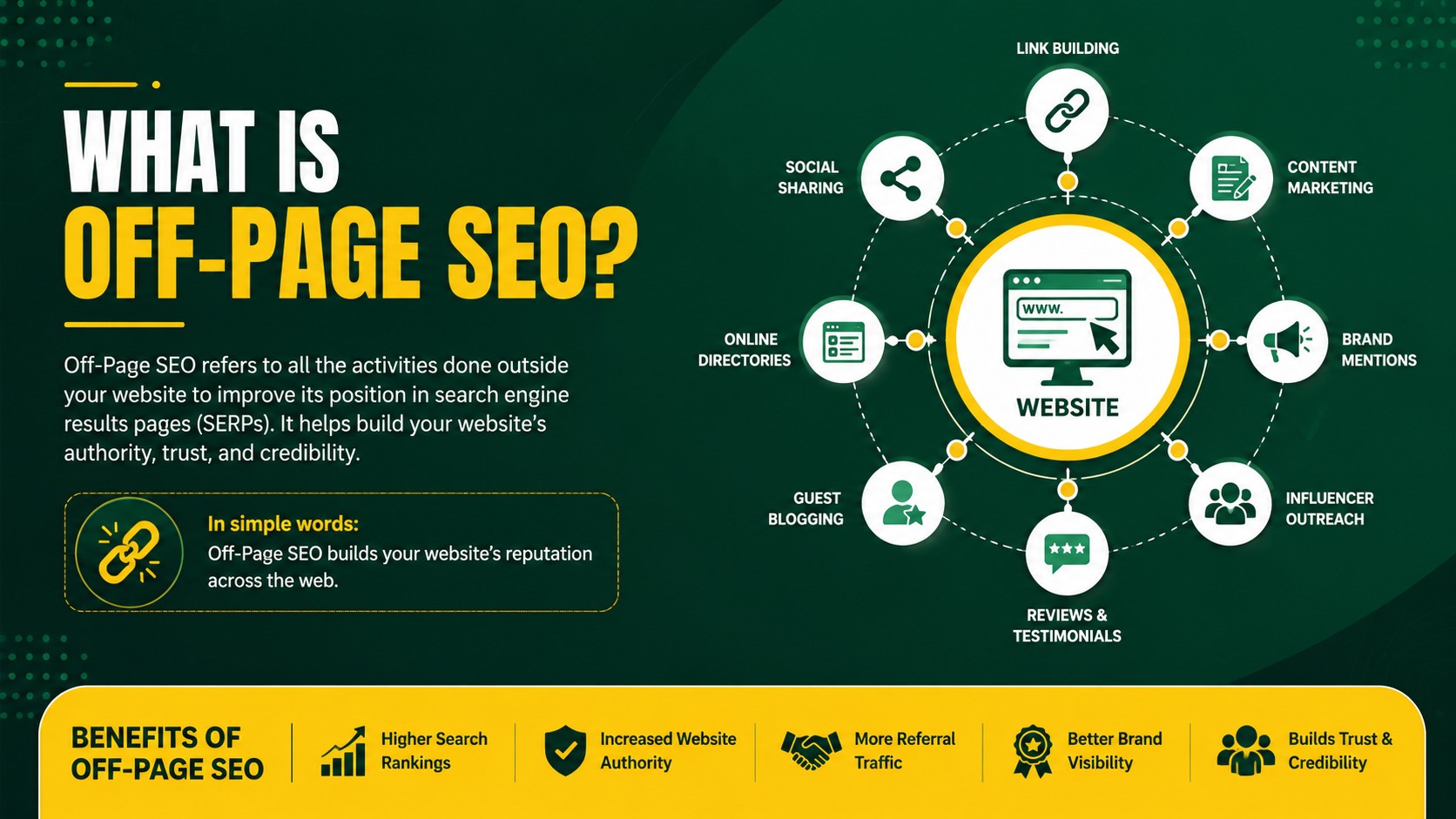
Off-page SEO (also called off-site SEO or off-page optimization) is every action taken outside your own website to improve how search engines and people judge your authority, reputation, and visibility.
It usually includes:
Link building is the core of most off-page SEO strategies, but it is not the whole job. A restaurant can rank better in local results because of consistent listings and recent reviews. A training institute can become easier to trust because education sites mention it by name. A software company can earn coverage because journalists cite its original data.
In each case, the work happens off your domain.
Search engines cannot sit in a classroom and decide who is an expert. They look for independent clues.
A backlink is the clearest clue. When Site A links to Site B, search engines treat that as a recommendation, especially if Site A is relevant and already trusted. Google has long confirmed that links are an important ranking signal. What has changed is how carefully those links are judged. A link from a respected industry publication carries more meaning than fifty links from unrelated blogs created only to pass “link juice.”
Off-page SEO also works through entity recognition. When your brand, people, and products appear in consistent, credible places, search systems get better at understanding who you are. That helps traditional rankings and can influence whether AI Overviews and answer engines treat you as a source worth citing.
A useful way to picture it: on-page SEO makes a page understandable, technical SEO makes a site crawlable, and off-page SEO supplies outside proof. None replaces the others. A well-linked thin page still struggles. A perfect page with no external proof often stays invisible in competitive searches.
Off-page SEO matters because search is a trust problem as much as a content problem.
Two websites can cover the same topic with similar keywords. The one that other relevant sites cite, mention, and send visitors to usually looks more reliable. That outside validation can support stronger visibility, referral traffic, branded search, local presence, and a clearer reputation for people and for AI systems that summarise the web.
It does not guarantee rankings. Off-page work strengthens your case. It cannot rescue a page that fails the searcher’s intent.
| Area | Where the work happens | Main job | Typical activities | How much control you have |
|---|---|---|---|---|
| On-page SEO | On your pages | Relevance and usefulness | Titles, content, headings, internal links, media | High |
| Technical SEO | Across the site’s infrastructure | Crawlability, indexation, performance | Speed, mobile usability, sitemaps, canonicals, structured data | High |
| Off-page SEO | Outside your website | Authority, reputation, discovery | Backlinks, PR, mentions, citations, reviews | Partial |
A simple test: if you can change it inside your CMS, it is probably on-page or technical. If you need someone else to mention, link, list, or review you, it is off-page.
Not every off-page tactic deserves the same time. In 2026, the useful ones create references that would still make sense if Google did not exist.
The strongest off-page signal is still a relevant backlink placed inside real content. If you run a digital marketing site, one contextual link from an education or marketing publication is usually more useful than a pile of unrelated directory links. Original research, useful guides, free tools, and unique data give other writers a reason to cite you.
Digital PR is the centre of serious off-page SEO in 2026. Instead of asking “Who will accept a guest post?”, ask “What story would an editor actually publish?” That might be a salary survey, a city-wise demand report, or a timely expert comment.
Journalist request platforms such as Connectively (formerly HARO) and public calls like #JournoRequest can help if the response is specific. Generic quotes rarely get used.
Guest posting still works when the host site has a real audience in your niche. A student writing a practical SEO case study for a respected marketing blog is guest posting. Paying for ten articles on unrelated “write for us” sites with the same exact-match anchor text is a link scheme.
Broken link building means finding a dead resource on a relevant page and offering your working page as a replacement. Link reclamation is even more direct: if a site already mentions your brand, course, or tool without linking, a polite request often turns that mention into a backlink.
Many industries still keep “recommended tools” or “useful links” pages. If your content fills a gap, a request is reasonable. The same logic applies to associations, colleges, event pages, and complementary businesses.
Google’s John Mueller has said that unlinked mentions do not pass link equity the way a hyperlink does. They are still useful. Repeated, credible mentions help people discover you, increase branded searches, and give search systems more evidence that your brand is a real entity. When a mention can fairly become a link, ask.
For any business that serves a city or area, off-page SEO includes a complete Google Business Profile, consistent name-address-phone (NAP) details, genuine reviews, and local coverage. In India, that often means Google Business Profile plus relevant platforms such as Justdial or IndiaMART — not every random directory. Accuracy beats volume.
Forums, podcasts, webinars, and creator collaborations can create awareness and occasional links. They work only when you add the answer first and the URL second. Social posts are not a confirmed Google ranking factor, but they put content in front of people who might cite it or search for the brand.
Use with caution: paid link insertions, private blog networks, mass guest posts, generic directories, social bookmarking blasts, and comment links. Google’s spam systems are much better at discounting these than they were a decade ago.
A useful backlink usually has several of these traits:
One relevant editorial link can outperform dozens of low-quality ones. Quality is the whole point.
A harmful or wasted backlink often comes from link farms, private blog networks, unrelated sites, automated pages, paid placements that exist only to manipulate rankings, exact-match anchors repeated at scale, and leftover directory or comment spam.
Not every low-value link is an emergency. Search engines ignore a lot of junk. The problem starts when junk becomes the pattern of your profile. If you inherit spammy links, review them in Google Search Console. Disavow is a last step after you understand the profile, not a weekly chore.
Use this sequence instead of collecting random activities.
This is slower than buying links. It is also the version that still works after the next spam update.
Do not start with 50 outreach emails. Complete your Google Business Profile if you serve a location. Publish one page worth citing. Set Google Alerts for your brand name. Reclaim any unlinked mentions you already have. Answer questions in one community your buyers actually use. Pitch one relevant guest article or journalist query you can answer well.
Experienced teams should build recurring digital PR around original research, map link gaps at page level, keep journalist relationships warm, refresh content when referring domains drop, and align author and organisation profiles so entity signals stay consistent. If trusted sites cite you, answer engines are more likely to recognise you too.
Tools do not build links. They help you see the map.
| Tool | Practical use |
|---|---|
| Google Search Console | Free view of links Google has found, plus the disavow file if needed |
| Google Alerts / brand monitoring | Unlinked mentions and press coverage |
| Ahrefs | Backlink profile, referring domains, competitor link gaps, broken pages |
| Semrush | Backlink analytics, toxic-link review, brand monitoring, listing management |
| Moz Link Explorer | Link research and Moz’s Domain Authority score |
| Majestic | Trust Flow / Citation Flow style link analysis |
| BrightLocal, Yext, or similar | Citation cleanup and review monitoring for local businesses |
| Connectively and journalist social requests | Expert commentary opportunities |
Moz’s Domain Authority, Semrush’s Authority Score, and similar metrics are third-party estimates. They can help you compare sites. They are not Google ranking factors.
Track a small set of numbers that describe real progress:
If referring domains rise but traffic and conversions do not, you may be collecting links that nobody uses. Off-page SEO is successful when authority and business results move together.
The tactic list has not exploded. The filter has.
Search systems and AI assistants now lean harder on sources that look independently trusted. That raises the value of digital PR, original data, expert identity, and consistent brand mentions. It lowers the value of manufactured link graphs.
For 2026, the practical shift is this: off-page SEO is less about collecting URLs and more about becoming a cited entity. Helpful content still needs outside confirmation. AI-assisted content makes that confirmation more important, not less, because search engines have more low-effort pages to ignore.
Do not assume every brand mention is a ranking factor, and do not assume links have stopped mattering. The winning pattern is still the same: publish something worth referencing, then put it in front of people who have a reason to reference it.
Off-page SEO is the reputation layer of search. It works by collecting independent evidence—links, mentions, listings, reviews, and coverage—that your pages deserve to be found.
Start with a page worth citing. Earn a few relevant references. Keep local and brand details consistent. Measure referring domains, traffic, and conversions instead of vanity scores. Leave the leftover tactics of the last decade where they belong.
If you treat off-page SEO as relationship-building rather than link-collecting, the strategy stays useful long after any single algorithm update.
Off-page SEO is the work you do outside your website to improve trust, authority, and visibility. It includes backlinks, brand mentions, digital PR, local citations, and reviews.
Search engines use external signals to decide which sources look reliable. Strong off-page SEO can support rankings, referral traffic, and brand recognition, especially in competitive niches.
The most durable techniques are editorial link building, digital PR, selective guest posting, broken-link and mention reclamation, resource-page links, and local citation/review management.
Yes. Links remain one of the best-known off-page signals. The emphasis has moved from volume to relevance, context, and the credibility of the linking site.
A high-quality backlink comes from a relevant, trusted page, sits naturally in the content, uses sensible anchor text, and preferably sends real visitors.
Create something other people need to cite, then use outreach, digital PR, guest articles on real publications, resource pages, and unlinked-mention reclamation. Buying random links is a poor substitute.
On-page SEO improves the content and HTML of your own pages. Off-page SEO improves how other websites and platforms refer to you.
Local listing and review work can show movement in weeks. Meaningful gains from digital PR and authority building usually take several months of consistent effort.
Google Search Console is the essential free starting point. Ahrefs, Semrush, Moz, and Majestic help you inspect referring domains, competitor gaps, and link quality.
No. Irrelevant, spammy, or manipulative links add little and can become a problem if they dominate the profile.
They are links from low-quality, irrelevant, automated, or scheme-like sites. Review them, request removal when practical, and use Google’s disavow tool only when the risk is clear.
Clean up business listings, publish one cite-worthy page, monitor brand mentions, reclaim existing mentions, and earn one relevant placement before scaling outreach.
Enroll Now and master the skills that are shaping tomorrow with our AI-powered courses:
Learn AI. Build Skills. Create Your Future.